Physics for your homeschool
Your child predicts what should happen, builds a model, and uses mathematics to test the prediction.
A lesson built around your child
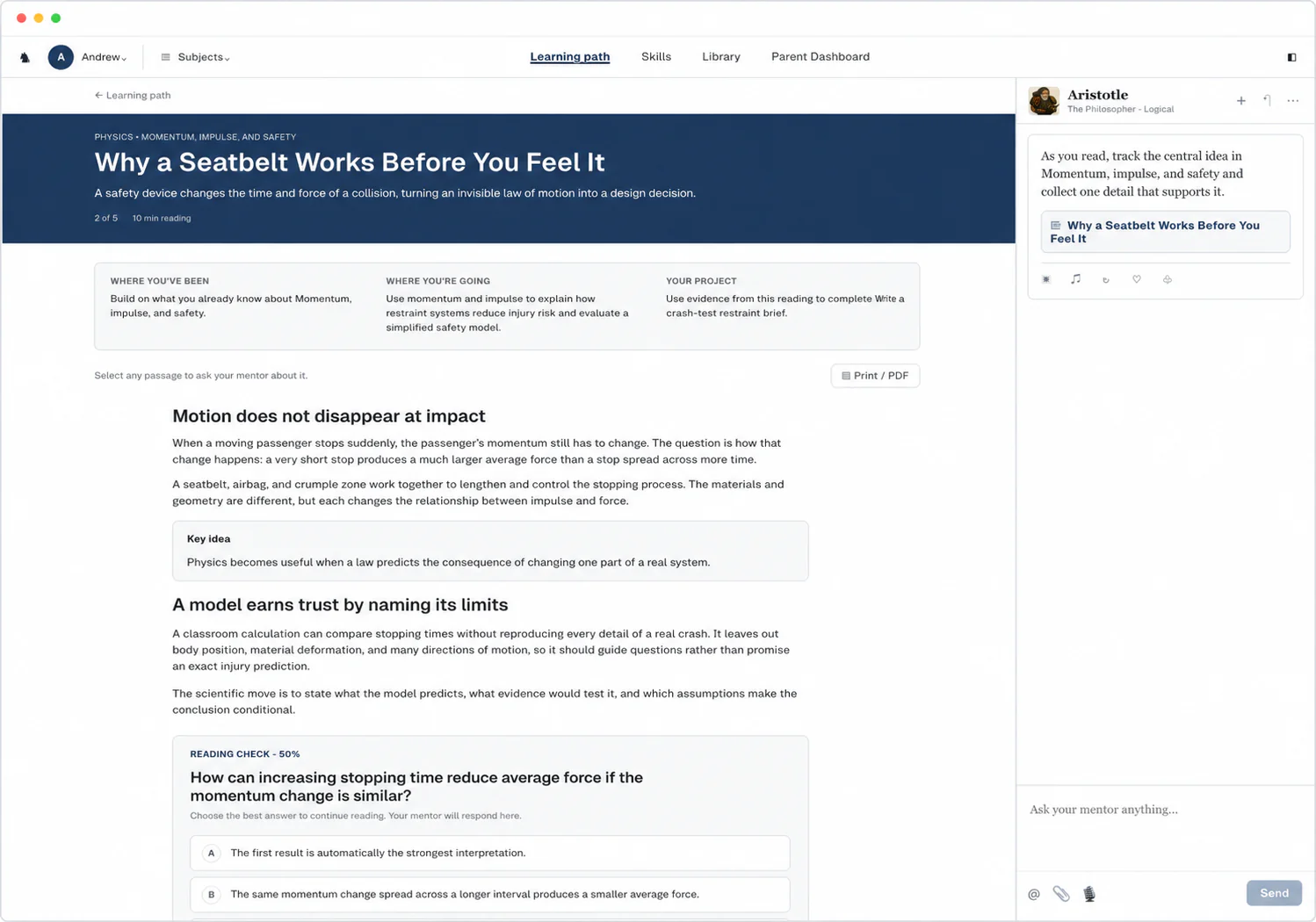
A safety device changes the time and force of a collision, turning an invisible law of motion into a design decision.
- Lesson
- Why a Seatbelt Works Before You Feel It
- Goal
- Use momentum and impulse to explain how restraint systems reduce injury risk and evaluate a simplified safety model.
How a lesson works
A 10-minute reading
This example lesson comes from the unit on momentum, impulse, and safety. It moves from “Motion does not disappear at impact” to “A model earns trust by naming its limits” and builds to one idea: physics becomes useful when a law predicts the consequence of changing one part of a real system.
Help inside the reading
When a force or motion problem feels confusing, our Always-On Mentor can help your child sketch what is happening before checking the calculation. Your child can also highlight any line of “Why a Seatbelt Works Before You Feel It” to ask about it or ask for a visual, and the mentor offers help on its own when they seem stuck.
A check halfway through
Your child answers “How can increasing stopping time reduce average force if the momentum change is similar?” before reading on, and the Reading Check at the end asks new questions.
A project your child hands in
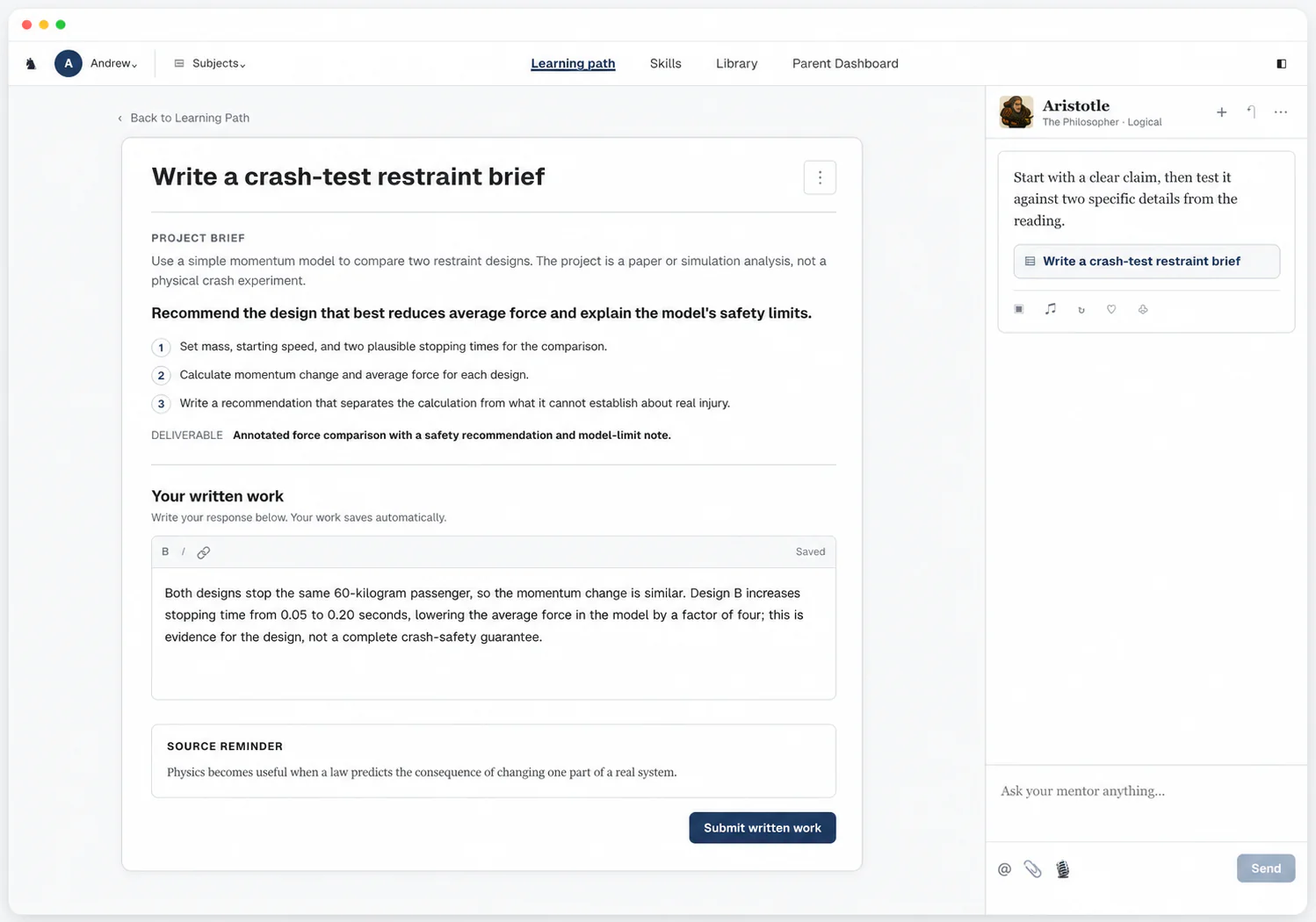
Use a simple momentum model to compare two restraint designs. The project is a paper or simulation analysis, not a physical crash experiment.
- Task
- Recommend the design that best reduces average force and explain the model's safety limits
- Hand in
- Annotated force comparison with a safety recommendation and model-limit note
Your parent dashboard
- Today
- Each subject's lesson, and whether it's done
- Grades
- Every submission graded instantly, with written feedback, so you never grade
- Records
- Attendance log and learning summary, ready to export

Units and skills by grade
Grades 3 to 5 each have their own physics units. From grade 6 through grade 12, physics is one full course: the same 7 units at every grade. Each grade adds a few skills of its own, and your child's grade sets how deep each unit goes.
Grade 35 units · 21 skills
Observing motion4 skills
- Describe the motion of an object in words
- Record the position of an object over time
- Compare the speed of two moving objects
- Predict where a moving object will be next
Pushes and pulls5 skills
- Identify a push or a pull acting on an object
- Explain how a larger push changes motion
- Explain how friction slows a moving object
- Compare motion on a smooth and a rough surface
- Change the direction of a moving object with a force
Gravity3 skills
- Explain that gravity pulls objects toward Earth
- Predict the path of a dropped object
- Compare how two objects fall
Forms of energy5 skills
- Identify mechanical energy in a moving object
- Identify light energy from a source
- Identify sound energy from a vibration
- Identify thermal energy moving between objects
- Trace energy from a source to its use
Light and sound4 skills
- Show that light travels in a straight path
- Explain how a shadow forms
- Explain how a vibration makes a sound
- Change the pitch of a sound and explain why
Grade 45 units · 22 skills
Measuring forces4 skills
- Measure a force with a spring scale
- Compare two forces acting on the same object
- Record force measurements in a table
- Draw a conclusion about force from collected data
Force and motion5 skills
- Predict motion when a stronger force is applied
- Explain how mass affects the motion produced by a force
- Explain how friction affects a rolling object
- Design a test that reduces friction
- Explain what keeps an object at rest
Magnetism4 skills
- Predict the interaction of two magnetic poles
- Test which materials a magnet attracts
- Explain how a magnet acts through a gap
- Use a magnet to separate a mixture
Energy transformations4 skills
- Trace an energy change from one form to another
- Identify the energy source in an everyday device
- Explain how energy is transferred by heating
- Compare energy in a stretched and a released band
Electrical circuits5 skills
- Build a complete electrical circuit
- Predict whether a circuit will light a bulb
- Compare a conductor with an insulator in a circuit
- Explain why a broken circuit stops working
- Draw a diagram of a working circuit
Grade 55 units · 22 skills
Investigating forces4 skills
- Write a hypothesis about a force and motion
- Identify the controlled variables in a motion test
- Graph position against time for a moving object
- Use repeated trials to support a motion claim
Balanced and unbalanced forces5 skills
- Predict motion when balanced forces act on an object
- Predict motion when unbalanced forces act on an object
- Explain a change in speed using forces
- Explain a change in direction using forces
- Compare the net force in two situations
Energy transfer5 skills
- Explain thermal energy transfer from warmer to cooler
- Compare how light behaves with different materials
- Explain how sound travels through a medium
- Trace energy transfer through a connected system
- Explain why energy transfer is not perfectly efficient
Circuits and electrical energy4 skills
- Design a circuit that meets a stated requirement
- Compare a series arrangement with a parallel arrangement
- Explain the role of a switch in a circuit
- Trace energy from a source through a circuit to a device
Light behaviour4 skills
- Explain reflection from a smooth surface
- Explain refraction when light enters water
- Predict the shadow cast by an object
- Explain how we see an object that makes no light
Grades 6 to 127 units · 79 skills
Motion12 skills
- Calculate speed from distance and time
- Calculate acceleration from a velocity-time graph
- Interpret slope on a position-time graph
- Use kinematic equations for constant acceleration
- Calculate displacement from a velocity-time graph
- Resolve velocity into components
- Analyze projectile motion horizontally
- Measure speed from a classroom investigation
- Use graphs to compare two motions
- Calculate average speed from position-time data
- Calculate projectile time of flight
- Use calculus notation for velocity
Forces14 skills
- Draw a free-body diagram
- Apply Newton's second law
- Calculate weight from mass
- Identify action-reaction force pairs
- Calculate friction force
- Analyze forces on an incline
- Apply Newton's third law in collisions
- Use balanced and unbalanced force evidence
- Draw a balanced force diagram
- Explain gravity and inertia in orbital motion
- Explain inertia in a vehicle stop
- Resolve forces into components
- Resolve a vector into components
- Analyze circular motion force
Energy13 skills
- Calculate kinetic energy
- Calculate gravitational potential energy
- Apply conservation of mechanical energy
- Calculate work from force and displacement
- Calculate spring potential energy
- Use power as work per time
- Identify nonconservative work
- Identify energy transfers in everyday systems
- Use conservation of energy in a ramp system
- Calculate final speed from energy on a ramp
- Interpret area under a force-displacement graph
- Connect energy conservation to modern physics contexts
- Relate mass-energy equivalence qualitatively
Momentum11 skills
- Calculate momentum
- Use impulse-momentum theorem
- Analyze a one-dimensional collision
- Distinguish elastic and inelastic collisions
- Use conservation of momentum in recoil
- Calculate impulse from a force-time graph
- Analyze explosion problems
- Analyze momentum in a cart collision
- Calculate momentum from mass and velocity
- Analyze two-dimensional momentum qualitatively
- Use impulse to explain a collision
Waves and electricity14 skills
- Calculate wave speed from frequency and wavelength
- Identify amplitude and period on a graph
- Apply Ohm's law
- Calculate electric power
- Use Coulomb's law
- Analyze a series circuit
- Analyze a parallel circuit
- Build a simple circuit model
- Use circuit diagrams with current and voltage
- Calculate current from voltage and resistance
- Use electric field models
- Map electric field direction
- Analyze electromagnetic induction qualitatively
- Explain electromagnetic induction
Rotational and modern physics8 skills
- Calculate torque from force and lever arm
- Identify center of mass in a simple system
- Explain photon energy qualitatively
- Interpret half-life from a decay graph
- Calculate angular speed
- Use rotational inertia qualitatively
- Explain photoelectric-effect evidence
- Use half-life to compare decay samples
Thermal and fluids7 skills
- Calculate density from mass and volume
- Explain pressure in a fluid
- Use buoyant force qualitatively
- Interpret a heating curve
- Use pressure-depth relationship qualitatively
- Explain thermal expansion
- Use Bernoulli effect qualitatively
Questions parents ask
Which grades can use this Physics curriculum?
- Grades 3 to 12. The skill trees on this page show the units and skills by grade. Placement checks your child's current skills, so the first lesson can sit before or after their grade.
What should my child know before starting?
- Starting skills include basic algebra helpful but not required, scientific reasoning skills, and curiosity about how things work. If placement finds a gap, the course starts with those skills.
How much of the teaching do I do?
- None of it. The course explains each new idea and checks how your child uses it, while the mentor answers questions as they work. Every submission is graded as soon as it comes in, so you never grade it yourself.
Can I use the record for high-school planning?
- Yes. The subject record holds every graded assignment with its written feedback, ready to export. We generate a transcript from the course records, ready for you to sign.
Physics, taught around your child
Physics that makes equations useful instead of intimidating.
$49/month after the trial.