History for your homeschool
Your child compares accounts of an event, asks whose perspective is missing, and writes an argument supported by sources.
A lesson built around your child
How Enlightenment ideas became political promises, and why those promises were never applied evenly.
- Lesson
- The Rights We Declare
- Goal
- Trace one idea from philosophy to declaration, then test who gained rights in practice.
How a lesson works
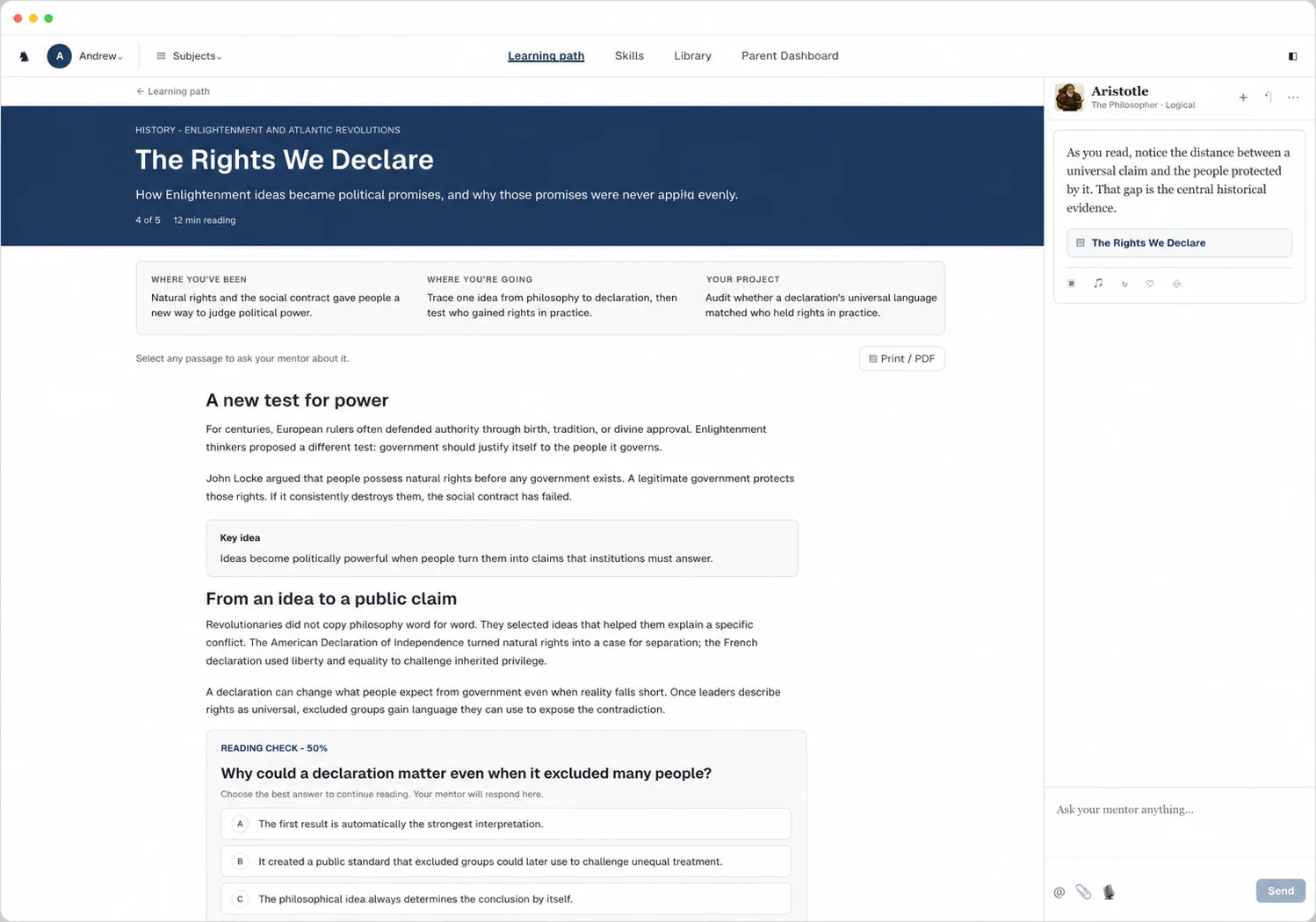
A 12-minute reading
This example lesson comes from the unit on Enlightenment and Atlantic revolutions. It moves from “A new test for power” to “From an idea to a public claim” and builds to one idea: ideas become politically powerful when people turn them into claims that institutions must answer.
Help inside the reading
If a history essay leans on one account, our Always-On Mentor can ask what another source says and help your child revise the argument without writing it. Your child can also highlight any line of “The Rights We Declare” to ask about it or ask for a visual, and the mentor offers help on its own when they seem stuck.
A check halfway through
Your child answers “Why could a declaration matter even when it excluded many people?” before reading on, and the Reading Check at the end asks new questions.
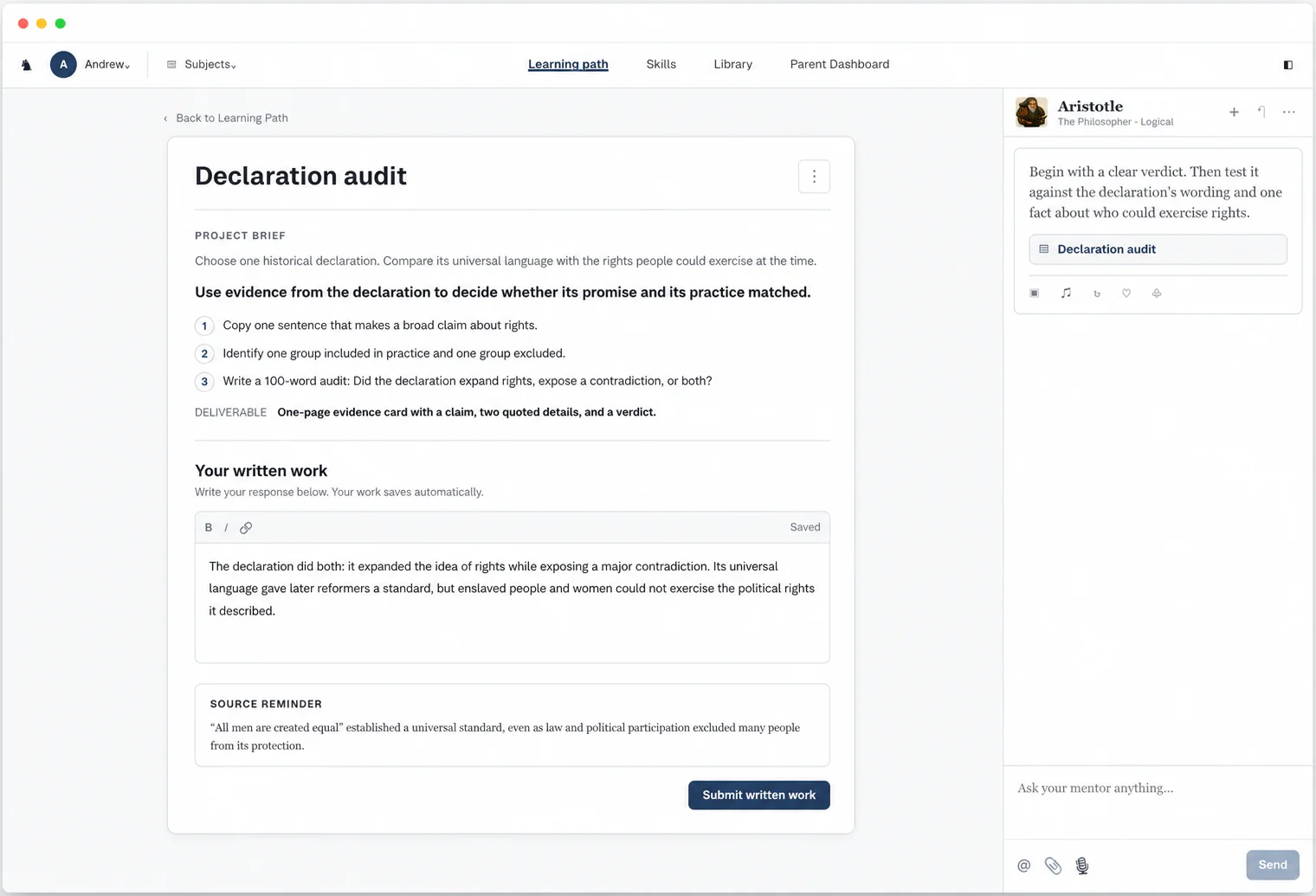
A project your child hands in
Choose one historical declaration. Compare its universal language with the rights people could exercise at the time.
- Task
- Use evidence from the declaration to decide whether its promise and its practice matched
- Hand in
- One-page evidence card with a claim, two quoted details, and a verdict
Your parent dashboard
- Today
- Each subject's lesson, and whether it's done
- Grades
- Every submission graded instantly, with written feedback, so you never grade
- Records
- Attendance log and learning summary, ready to export

Units and skills by grade
Grade 35 units · 25 skills
How communities change4 skills
- Compare a community in the past with the same community today
- Sequence events on a community timeline
- Explain how transportation changed daily life
- Explain how a community grew around a resource
People who shaped communities7 skills
- Explain why a community honours a founder
- Describe a contribution of Benjamin Franklin
- Describe a contribution of Harriet Tubman
- Explain how one person's choice affected many people
- Describe a contribution of George Washington
- Describe a contribution of Thomas Edison
- Describe a contribution of Susan B. Anthony
Heroes and holidays5 skills
- Explain why Independence Day is observed
- Explain why Martin Luther King Jr. Day is observed
- Explain why Memorial Day is observed
- Connect a holiday to the event it remembers
- Explain why Thanksgiving is observed
Evidence from the past4 skills
- Use a photograph as evidence about the past
- Use an artifact to infer how people lived
- Distinguish a primary from a secondary source
- Explain what a source cannot tell you
Local and national stories5 skills
- Explain the origin of a local landmark
- Retell a founding story of the United States
- Compare two accounts of the same event
- Explain why the Statue of Liberty was given to the United States
- Explain what happened at the first Fourth of July
Grade 46 units · 26 skills
First peoples of North America5 skills
- Describe how Northwest Coast nations used their environment
- Describe how Great Plains nations used their environment
- Describe how Eastern Woodlands nations used their environment
- Compare two American Indian nations from different regions
- Explain how trade connected American Indian nations
Exploration and encounter5 skills
- Explain why European nations sent explorers across the Atlantic
- Describe the first voyage of Christopher Columbus and its effects
- Compare the routes of two European explorers
- Explain what the Columbian Exchange moved between continents
- Explain how contact with Europeans changed American Indian life
First European settlements4 skills
- Describe the founding of St. Augustine
- Explain why the Jamestown settlement struggled
- Explain why the Pilgrims settled at Plymouth
- Compare Spanish, French, and English settlements
Geography shapes history4 skills
- Explain how rivers shaped where early settlements grew
- Explain how the Appalachian Mountains limited early settlement
- Explain how a natural resource drew settlers to a region
- Explain why harbors became trading centers
From territory to state4 skills
- Explain how a territory became a state
- Explain why the United States added states over time
- Sequence the addition of states on a timeline
- Explain how a new state chose its capital
Using historical evidence4 skills
- Use a primary source to describe life in early North America
- Interpret a historical map of exploration routes
- Sequence exploration and settlement events on a timeline
- Compare two accounts of the same encounter
Grade 56 units · 26 skills
Colonial America4 skills
- Explain why Europeans established colonies in North America
- Compare the New England and Southern colonies
- Describe daily life in a colonial settlement
- Explain the effects of colonization on American Indian nations
The American Revolution5 skills
- Explain the causes of the American Revolution
- Explain the purpose of the Declaration of Independence
- Describe the role of George Washington in the Revolution
- Explain the significance of the Battle of Yorktown
- Sequence the major events of the Revolution
Founding a government4 skills
- Explain why the Articles of Confederation were replaced
- Explain the purpose of the Constitution
- Explain the purpose of the Bill of Rights
- Describe a compromise made at the Constitutional Convention
Expansion and conflict5 skills
- Explain the causes of westward expansion
- Explain the effects of expansion on American Indian nations
- Explain the causes of the Civil War
- Explain the effects of the Civil War on the United States
- Explain the purpose of the Emancipation Proclamation
A changing nation4 skills
- Explain how industry changed American life
- Explain why people immigrated to the United States
- Describe a change brought by a new invention
- Explain how civil rights leaders changed American law
Historical reasoning4 skills
- Use a primary source to support a claim about the past
- Distinguish a cause from an effect
- Sequence events across a century
- Compare two interpretations of the same event
Grade 612 units · 53 skills
Historical methods for ancient worlds5 skills
- Distinguish artifact, primary source, secondary interpretation, chronology, and context
- Build a timeline using BCE/CE, sequence, duration, and turning point language
- Infer limits of evidence from archaeology, inscriptions, oral traditions, and later texts
- Compare two ancient-world sources by author, purpose, audience, and reliability
- Defend a Grade 6 historical claim about historical methods for ancient worlds using conflicting evidence
River valley civilizations4 skills
- Explain how Mesopotamian city-states used irrigation, writing, temples, and law codes
- Analyze Egyptian state power through Nile ecology, pharaohs, bureaucracy, and monument building
- Compare Indus Valley urban planning, trade, sanitation, and unresolved source questions
- Trace early Chinese dynastic authority through geography, ritual, writing, and mandate claims
Agriculture, cities, and social order5 skills
- Explain the Neolithic shift from foraging to farming using evidence and tradeoffs
- Connect surplus, specialization, hierarchy, taxation, and record keeping in early cities
- Compare slavery, labor obligations, gender roles, and class structure in ancient societies
- Evaluate how geography shaped food, settlement, defense, and exchange in early states
- Defend a Grade 6 historical claim about agriculture, cities, and social order using conflicting evidence
Ancient law, religion, and power4 skills
- Analyze Hammurabi-style law as evidence of order, hierarchy, punishment, and authority
- Explain how priesthoods, temples, rituals, and sacred kingship legitimized ancient power
- Compare polytheistic traditions and state religion in Mesopotamia, Egypt, Greece, and Rome
- Assess how myths and origin stories preserved values, memory, and political claims
Classical Greece5 skills
- Compare Athens, Sparta, and other poleis by citizenship, military organization, and values
- Explain Athenian direct democracy, exclusion, debate, empire, and civic participation
- Analyze Persian Wars and Peloponnesian War as turning points in Greek power and identity
- Use Greek art, drama, philosophy, and history writing as evidence of cultural priorities
- Defend a Grade 6 historical claim about classical greece using conflicting evidence
Roman Republic and Empire4 skills
- Explain Roman Republic institutions, patronage, citizenship, and checks on power
- Trace Roman expansion from republic to empire using military, economic, and political causes
- Analyze Julius Caesar, Augustus, and imperial rule as evidence of republican breakdown
- Evaluate Roman law, roads, cities, slavery, and citizenship as tools of imperial integration
South Asia and Buddhist worlds4 skills
- Explain Mauryan rule, Ashoka, edicts, Buddhism, and imperial moral authority
- Analyze caste, dharma, kingship, trade, and religious change in ancient South Asia
- Trace Buddhist spread across Asia through merchants, monks, rulers, and translation
- Compare Hindu, Buddhist, and Jain ideas through duty, liberation, nonviolence, and practice
East Asia and classical China5 skills
- Explain Qin standardization, Legalism, bureaucracy, walls, and imperial consolidation
- Analyze Han rule through Confucianism, civil service, Silk Roads, and frontier policy
- Compare Confucian, Daoist, and Legalist views of order, family, state, and human nature
- Use Chinese inventions, texts, and material evidence to explain continuity and change
- Defend a Grade 6 historical claim about east asia and classical china using conflicting evidence
Exchange networks and empires4 skills
- Map Silk Road exchange of goods, beliefs, technologies, disease, and political influence
- Compare land and sea trade routes by geography, risk, intermediaries, and cultural contact
- Explain how empires used roads, coins, languages, and law to govern diverse peoples
- Assess exchange as both connection and disruption using evidence from multiple regions
Late antiquity and world religions4 skills
- Trace the rise and spread of Christianity inside and beyond the Roman Empire
- Explain Jewish diaspora, preservation of identity, imperial pressure, and religious memory
- Compare religious diffusion through conquest, trade, mission, migration, and state sponsorship
- Analyze late-antique transformations as continuity, crisis, adaptation, and new religious and political forms
Ancient-world comparison4 skills
- Compare two ancient civilizations using governance, environment, labor, belief, and exchange
- Construct a causation paragraph explaining why one ancient state expanded or declined
- Use archaeological and written evidence together without overstating what either proves
- Evaluate whether ancient empires solved or intensified problems of diversity and distance
Ancient history capstone5 skills
- Build an evidence-backed museum exhibit label for an ancient-world artifact
- Defend a claim about state power in an ancient civilization using three source types
- Compare classical societies by citizenship, empire, labor, gender, and political legitimacy
- Present a historical argument with claim, evidence, context, counterclaim, and limits
- Defend a Grade 6 historical claim about ancient history capstone using conflicting evidence
Grade 712 units · 54 skills
Post-classical historical methods5 skills
- Explain periodization by distinguishing ancient, medieval, post-classical, and early modern labels
- Use maps to compare political fragmentation, trade routes, religious zones, and empire boundaries
- Corroborate a travel account with a map, artifact, legal source, or later interpretation
- Identify continuity and change across 500-1750 without treating Europe as the whole story
- Defend a Grade 7 historical claim about post-classical historical methods using conflicting evidence
Byzantine and Islamic worlds4 skills
- Explain Byzantine preservation, Orthodox Christianity, Justinian law, and imperial geography
- Trace the rise of Islam through Arabian context, revelation, community, and caliphate expansion
- Analyze Abbasid Baghdad as a center of translation, science, trade, and administration
- Compare Sunni-Shia divisions, legal traditions, and political authority in Islamic history
African kingdoms and trade5 skills
- Explain Ghana, Mali, and Songhai through gold-salt trade, Islam, taxation, and geography
- Analyze Mansa Musa's pilgrimage as evidence of wealth, faith, diplomacy, and global connection
- Compare Swahili coast city-states through Indian Ocean trade, Islam, language, and architecture
- Use oral tradition and archaeology to reason carefully about African political history
- Defend a Grade 7 historical claim about african kingdoms and trade using conflicting evidence
Medieval Europe4 skills
- Explain feudal obligations, manorialism, Church authority, and local political order
- Analyze the Crusades through religious, political, economic, and cross-cultural causes
- Assess Magna Carta, Parliament, and legal limits on monarchy as institutional changes
- Explain the Black Death through trade networks, social disruption, labor, and religious response
South and Southeast Asia5 skills
- Compare Delhi Sultanate and Mughal foundations through rule, religion, military power, and culture
- Analyze Hindu-Buddhist and Islamic interactions in South Asian politics and society
- Explain Angkor, Srivijaya, and maritime Southeast Asia through water, temples, and trade
- Use art and architecture as evidence for cultural exchange and political authority
- Defend a Grade 7 historical claim about south and southeast asia using conflicting evidence
East Asia after Han4 skills
- Explain Tang and Song governance, exams, urbanization, printing, commerce, and technology
- Compare samurai Japan, Heian court culture, shogunate power, and social hierarchy
- Analyze Mongol conquest, Yuan rule, trade protection, and cross-Eurasian exchange
- Assess Ming voyages and later restrictions through state priorities and maritime power
Americas before Columbus4 skills
- Compare Maya city-states, calendars, writing, warfare, and environmental constraints
- Explain Mexica-Aztec power through tribute, military alliances, religion, and city planning
- Analyze Inca roads, labor obligations, quipu, terraces, and imperial integration
- Evaluate how geography shaped political forms in Mesoamerica, Andes, and North America
Renaissance, Reformation, and science5 skills
- Explain Renaissance humanism, patronage, printing, city-states, and classical revival
- Analyze Reformation causes through theology, printing, politics, corruption, and state power
- Compare Catholic reform, religious wars, and toleration as responses to fragmentation
- Trace scientific revolution claims through observation, mathematics, instruments, and authority
- Defend a Grade 7 historical claim about renaissance, reformation, and science using conflicting evidence
Exploration and Columbian Exchange5 skills
- Explain Portuguese and Spanish expansion through navigation, trade, conquest, and state rivalry
- Analyze Columbian Exchange effects on disease, crops, animals, labor, population, and environment
- Compare Indigenous, African, and European experiences of conquest and exchange
- Use maps and demographic evidence to explain global change after 1492
- Trace Zheng He, Prince Henry, Dias, da Gama, Columbus, and Magellan across motives, routes, and consequences
Atlantic slavery and empire4 skills
- Explain Atlantic slavery through plantation demand, racial ideology, law, violence, and profit
- Analyze resistance through maroon communities, rebellion, everyday survival, and culture
- Compare Spanish, Portuguese, French, Dutch, and English imperial systems in the Americas
- Evaluate mercantilism, chartered companies, and colonial trade as state-backed economic systems
Gunpowder empires and absolutism4 skills
- Compare Ottoman, Safavid, Mughal, and Qing state-building through military, taxation, and legitimacy
- Explain European absolutism and constitutionalism through Louis XIV, Parliament, and fiscal states
- Analyze religious diversity and state control in early modern empires
- Assess how gunpowder, bureaucracy, and trade reshaped power between 1450 and 1750
Early modern global history capstone5 skills
- Build a comparative argument about two early modern empires using political and economic evidence
- Explain a global exchange network with causes, participants, commodities, coercion, and effects
- Evaluate a source from travel, trade, mission, or conquest for perspective and limits
- Present a claim about 500-1750 global change with evidence, counterclaim, and map support
- Defend a Grade 7 historical claim about early modern global history capstone using conflicting evidence
Grade 812 units · 55 skills
Indigenous and colonial worlds5 skills
- Compare Indigenous nations before colonization by governance, diplomacy, economy, and land use
- Explain European colonization through charter, religion, labor demand, commerce, and empire rivalry
- Analyze colonial regions by economy, slavery, settlement pattern, religion, and political culture
- Use maps and sources to explain conflict, alliance, and exchange in early North America
- Defend a Grade 8 historical claim about indigenous and colonial worlds using conflicting evidence
Imperial crisis and revolutionary ideas5 skills
- Explain taxation without representation through imperial debt, Parliament, colonies, and protest
- Analyze natural rights, consent, republicanism, liberty, property, slavery, and popular sovereignty
- Compare Patriot, Loyalist, Indigenous, enslaved, and women's perspectives on revolution
- Use pamphlets, petitions, sermons, and declarations to trace revolutionary ideology
- Compare Locke, Montesquieu, Paine, Adams, Jefferson, and Otis on natural rights and resistance
American Revolution war6 skills
- Lexington and Concord
- Battle of Saratoga
- Valley Forge
- Battle of Yorktown
- Defend a Grade 8 historical claim about american revolution war using conflicting evidence
- Explain why geography, French alliance, logistics, morale, and leadership shaped Revolutionary War outcomes
American Revolution outcomes4 skills
- Treaty of Paris 1783
- Explain how the Revolution changed and failed to change slavery, citizenship, gender, and property
- Analyze state constitutions, republican experiments, and conflicts over representation
- Compare revolutionary rhetoric with limits on equality in the new United States
Constitution and early republic5 skills
- Federalist No. 10
- Marbury v. Madison
- Explain Articles of Confederation weaknesses and the Constitutional Convention compromises
- Compare Federalist and Anti-Federalist arguments over power, rights, factions, and republic size
- Defend a Grade 8 historical claim about constitution and early republic using conflicting evidence
Early republic policy and identity4 skills
- War of 1812
- Monroe Doctrine
- Analyze political parties, Hamiltonian finance, Jeffersonian republicanism, and executive power
- Explain nationalism, sectionalism, market growth, and foreign policy in the early republic
Expansion, removal, and market revolution4 skills
- Explain Louisiana Purchase, Manifest Destiny, and westward expansion through opportunity and coercion
- Analyze Indian Removal, Cherokee resistance, and federal power through law and human consequences
- Compare market revolution effects on labor, gender, transportation, cities, and regional economies
- Use maps to explain settlement, migration, canals, railroads, cotton, and territorial conflict
Slavery, reform, and sectional conflict5 skills
- Missouri Compromise
- Kansas-Nebraska Act
- Dred Scott v. Sandford
- Analyze abolition, women's rights, religious reform, resistance to slavery, and sectional politics
- Defend a Grade 8 historical claim about slavery, reform, and sectional conflict using conflicting evidence
Civil War causes and war4 skills
- Fort Sumter
- Battle of Antietam
- Battle of Gettysburg
- Siege of Vicksburg
Civil War emancipation and memory4 skills
- Gettysburg Address
- Appomattox surrender
- Explain emancipation as military policy, moral argument, self-emancipation, and constitutional change
- Compare Union and Confederate war aims, resources, strategy, casualties, and political leadership
Reconstruction and unfinished freedom4 skills
- Black Codes
- Compromise of 1877
- Analyze Reconstruction amendments, Freedmen's Bureau, Black political participation, and white resistance
- Evaluate whether Reconstruction was a revolution, failure, unfinished project, or contested settlement
U.S. founding to Reconstruction capstone5 skills
- Defend an interpretation of the American Revolution using ideology, military events, and social limits
- Compare the Constitution and Reconstruction amendments as competing answers to union and liberty
- Build a Civil War causation argument using slavery, politics, economics, ideology, and federal power
- Present a source-based argument about freedom, citizenship, and equality from 1763 to 1877
- Defend a Grade 8 historical claim about u.s. founding to reconstruction capstone using conflicting evidence
Grade 912 units · 56 skills
Modern world methods5 skills
- Contextualize a world-history document by author, audience, purpose, and historical situation
- Build a causation chain with long-term, short-term, triggering, and contingent causes
- Compare continuity and change across 1750-1914 using region-specific evidence
- Use map, demographic, economic, and political evidence to test a world-history claim
- Defend a Grade 9 historical claim about modern world methods using conflicting evidence
Enlightenment and revolutionary ideas5 skills
- Analyze natural rights, sovereignty, social contract, equality, property, and citizenship claims
- Compare Locke, Rousseau, Montesquieu, Wollstonecraft, and abolitionist arguments
- Explain how print culture, salons, revolts, and state crisis spread revolutionary ideology
- Evaluate contradictions between universal rights language and slavery, empire, gender, and class
- Compare Locke, Rousseau, Wollstonecraft, Smith, and Bolivar on rights, sovereignty, gender, and economy
Atlantic revolutions5 skills
- Compare American Revolution influence on later Atlantic revolutions without making it the whole course
- Analyze French Revolution phases through fiscal crisis, popular politics, terror, and empire
- Explain Haitian Revolution as anti-slavery, anti-colonial, and Atlantic revolutionary history
- Compare Latin American independence movements by social hierarchy, leadership, and imperial crisis
- Defend a Grade 9 historical claim about atlantic revolutions using conflicting evidence
Industrial Revolution and capitalism5 skills
- Explain industrialization through coal, steam, textiles, labor discipline, finance, and patents
- Analyze factory work, child labor, urbanization, public health, and class conflict
- Compare capitalist, socialist, liberal, and conservative responses to industrial society
- Use economic and demographic evidence to explain uneven industrial development
- Analyze factory discipline, wage labor, urbanization, railroads, and class formation using industrial data
Nationalism and state-building5 skills
- Explain nationalism through language, culture, schooling, military service, and political myth
- Compare Italian and German unification through diplomacy, war, liberalism, and realpolitik
- Analyze Ottoman, Habsburg, and Russian imperial diversity under nationalist pressure
- Evaluate nationalism as both liberation movement and exclusionary state project
- Defend a Grade 9 historical claim about nationalism and state-building using conflicting evidence
Imperialism and colonial rule4 skills
- Analyze New Imperialism through industrial demand, strategic rivalry, racism, missions, and technology
- Explain the Berlin Conference and African partition using maps, diplomacy, violence, and resources
- Compare colonial rule in India, Africa, and Southeast Asia by extraction, law, resistance, and education
- Evaluate primary sources defending and resisting empire for assumptions and power claims
East Asia and global pressure4 skills
- Explain Opium Wars, unequal treaties, Taiping rebellion, and Qing reform pressures
- Analyze Meiji Restoration modernization through state power, industry, military, and empire
- Compare Chinese, Japanese, and Korean responses to Western and regional pressure
- Use treaty, map, and reform evidence to explain sovereignty under global capitalism
Reform, reaction, and mass politics5 skills
- Analyze abolition, suffrage, labor movements, and public education as mass political projects
- Compare liberalism, conservatism, socialism, anarchism, and nationalism in the 19th century
- Explain how newspapers, parties, unions, and associations expanded political participation
- Evaluate reform and repression as competing responses to industrial and political change
- Defend a Grade 9 historical claim about reform, reaction, and mass politics using conflicting evidence
World War I causes5 skills
- Explain militarism, alliances, imperial rivalry, nationalism, and crisis diplomacy before 1914
- Analyze Balkan nationalism and the July Crisis through contingency and decision-making
- Compare long-term structural causes and short-term triggers of World War I
- Use diplomatic documents and maps to build a multi-causal explanation of war
- Build a causal chain from alliance systems, militarism, imperial rivalry, nationalism, and crisis diplomacy to World War I
World War I experience and aftermath4 skills
- Analyze trench warfare, total war, propaganda, home fronts, empire troops, and casualties
- Explain Russian Revolution through war, monarchy, workers, peasants, parties, and Bolshevik strategy
- Evaluate Wilsonian self-determination, Treaty of Versailles, mandates, and unresolved grievances
- Compare memories of World War I across victors, defeated states, colonies, and revolutionaries
AP exam readiness4 skills
- Write a document sourcing note for a 1750-1914 world-history source
- Build a contextualization paragraph for Atlantic revolutions or industrialization
- Group evidence for comparison across empire, revolution, nationalism, and industrial change
- Draft a thesis that answers a causation or comparison prompt with defensible categories
Modern world history I capstone5 skills
- Defend a claim about whether ideology or material change drove 1750-1914 transformations
- Compare two revolutions using causes, participants, ideology, violence, and outcomes
- Analyze imperialism through economic motive, racial ideology, state power, and resistance
- Present a source-based argument connecting industrialization, nationalism, and war
- Defend a Grade 9 historical claim about modern world history i capstone using conflicting evidence
Grade 1012 units · 57 skills
Twentieth-century historical methods5 skills
- Analyze propaganda, photograph, memoir, speech, statistic, and government document as different evidence types
- Distinguish immediate cause, structural cause, ideology, contingency, and consequence in 20th-century history
- Compare national, imperial, ideological, and civilian perspectives on the same event
- Evaluate memory, commemoration, denial, and historiography as part of modern historical argument
- Defend a Grade 10 historical claim about twentieth-century historical methods using conflicting evidence
Interwar crisis and fascism4 skills
- Explain Weimar crisis, hyperinflation, depression, political violence, and Nazi rise to power
- Compare fascism, communism, liberal democracy, and authoritarian nationalism in the interwar period
- Analyze propaganda, scapegoating, paramilitary violence, and mass politics in authoritarian movements
- Explain Japanese militarism, Italian fascism, and German Nazism as distinct but comparable movements
World War II global conflict6 skills
- Explain World War II causes through treaty grievances, depression, ideology, appeasement, and empire
- Analyze Blitzkrieg, Battle of Britain, Pearl Harbor, Stalingrad, D-Day, and island hopping as strategic turning points
- Compare home fronts, rationing, propaganda, women's labor, colonial troops, and civilian bombing
- Evaluate the atomic bomb decision through military, diplomatic, ethical, and civilian evidence
- Defend a Grade 10 historical claim about world war ii global conflict using conflicting evidence
- Compare total war strategies in Europe, North Africa, the Pacific, and the home fronts
Holocaust, genocide, and human rights5 skills
- Analyze antisemitism, racial ideology, bureaucracy, ghettos, Einsatzgruppen, camps, and genocide escalation
- Compare bystanders, collaborators, rescuers, resisters, victims, and perpetrators using careful evidence
- Explain Armenian genocide memory, post-1945 genocide law, and later genocide warning signs
- Evaluate Universal Declaration of Human Rights as response, aspiration, and contested political document
- Use survivor testimony and perpetrator documents to explain Holocaust evidence and historical responsibility
Decolonization and new states6 skills
- Explain Indian independence and Partition through nationalism, empire, religion, violence, and migration
- Analyze African decolonization through Pan-Africanism, armed struggle, negotiation, borders, and resources
- Compare Algeria, Ghana, Vietnam, Indonesia, and Kenya as different decolonization pathways
- Evaluate postcolonial challenges through state-building, Cold War pressure, debt, ethnicity, and development
- Defend a Grade 10 historical claim about decolonization and new states using conflicting evidence
- Compare Indian, Algerian, Ghanaian, Vietnamese, and Kenyan decolonization paths
Cold War global system4 skills
- Explain containment, deterrence, arms race, proxy wars, espionage, and ideological competition
- Compare Berlin, Korea, Cuba, Vietnam, Afghanistan, and Latin America as Cold War flashpoints
- Analyze nonalignment and Third World politics as active strategy rather than passive background
- Evaluate Cold War culture, science, space race, and nuclear fear as historical evidence
Communist revolutions and reforms4 skills
- Explain Chinese Revolution, Maoism, Great Leap Forward, Cultural Revolution, and reform-era change
- Compare Soviet Stalinism, Khrushchev reform, stagnation, dissidence, and collapse
- Analyze Cuba, Vietnam, and other revolutionary states through ideology, war, development, and repression
- Evaluate revolutionary promises against social, economic, political, and human costs
Middle East and global conflict5 skills
- Explain Ottoman collapse, mandates, nationalism, oil, Zionism, and Palestinian displacement
- Analyze Arab-Israeli wars, Iranian Revolution, Gulf conflicts, and U.S./Soviet involvement
- Compare secular nationalism, political Islam, monarchy, republic, and military rule
- Use maps and source perspectives to avoid one-cause explanations of regional conflict
- Defend a Grade 10 historical claim about middle east and global conflict using conflicting evidence
Globalization, environment, and technology4 skills
- Analyze globalization through trade, finance, migration, supply chains, institutions, and inequality
- Explain environmental history through climate change, energy, extraction, conservation, and justice
- Compare digital revolution effects on communication, labor, politics, surveillance, and culture
- Evaluate winners, losers, tradeoffs, and evidence limits in globalization claims
Contemporary democracy and authoritarianism5 skills
- Compare post-Cold War democratization, authoritarian resilience, populism, and civil society
- Analyze ethnic conflict, refugee crises, terrorism, counterterrorism, and state violence with precision
- Explain European integration, China's rise, post-Soviet politics, and shifting global power
- Evaluate present-day history using caution about incomplete evidence and live political stakes
- Evaluate democratization and authoritarian durability using institutions, coercion, media, and civil society
AP exam readiness4 skills
- Write a document sourcing note for a 20th-century political or social source
- Build a contextualization paragraph for World War II, decolonization, or Cold War prompts
- Group evidence for continuity and change across 1900-present world history
- Draft a thesis that distinguishes ideology, state power, economy, and society
Modern world history II capstone5 skills
- Defend a claim about whether ideology, empire, or technology most shaped the 20th century
- Compare two decolonization movements using strategy, social base, empire response, and outcomes
- Analyze genocide or human rights history through law, memory, state power, and evidence limits
- Present a source-based argument about Cold War global effects beyond Europe and the United States
- Defend a Grade 10 historical claim about modern world history ii capstone using conflicting evidence
Grade 1112 units · 58 skills
Historical argument6 skills
- Periodize U.S. history after Reconstruction using turning points and competing interpretations
- Corroborate a political cartoon with a statute, speech, court case, or economic statistic
- Distinguish social, political, economic, cultural, and constitutional evidence in a DBQ-style argument
- Write a defensible thesis using causation, comparison, or continuity-and-change categories
- Defend a Grade 11 historical claim about historical argument using conflicting evidence
- Use Supreme Court cases as historical evidence
Gilded Age industrialization5 skills
- Transcontinental Railroad
- Chinese Exclusion Act
- Analyze corporations, trusts, labor conflict, immigration, urbanization, and political machines
- Compare Social Darwinism, Gospel of Wealth, labor republicanism, populism, and regulation arguments
- Analyze railroad land grants, federal policy, Native dispossession, and corporate power in western expansion
Progressive Era and imperialism6 skills
- Plessy v. Ferguson
- Federal Reserve Act
- Analyze muckraking, settlement houses, women's suffrage, prohibition, conservation, and expertise
- Compare U.S. imperialism in Hawaii, Cuba, Puerto Rico, the Philippines, and Panama
- Defend a Grade 11 historical claim about progressive era and imperialism using conflicting evidence
- Evaluate Progressive reform through race, class, gender, expertise, and constitutional limits
World War I and the 1920s4 skills
- Fourteen Points
- Explain mobilization, dissent, Espionage Act, Great Migration, Red Scare, and treaty debate
- Analyze consumer culture, Harlem Renaissance, immigration restriction, religion, and modernism
- Compare 1920s prosperity narratives with inequality, nativism, racial violence, and labor conflict
Great Depression and New Deal5 skills
- Analyze stock crash, banking collapse, unemployment, Dust Bowl, and global depression causes
- Explain New Deal relief, recovery, reform, labor policy, Social Security, and federal expansion
- Compare New Deal critics from left, right, business, populist, and constitutional perspectives
- Evaluate New Deal effects on race, gender, labor, region, party coalitions, and state capacity
- Defend a Grade 11 historical claim about great depression and new deal using conflicting evidence
World War II home front and global power4 skills
- Japanese American incarceration
- Explain wartime mobilization, women's labor, African American activism, rationing, and propaganda
- Analyze U.S. strategy, alliance politics, Holocaust response, and atomic diplomacy
- Evaluate how World War II transformed federal power, civil rights claims, and global leadership
Cold War and suburban America4 skills
- Berlin Airlift
- Explain containment, NATO, Korea, McCarthyism, nuclear culture, and national security institutions
- Analyze suburbanization, highways, consumer credit, television, gender norms, and racial exclusion
- Compare consensus culture with dissent, poverty, immigration, and challenges to conformity
Civil rights and social movements6 skills
- Brown v. Board of Education
- Civil Rights Act of 1964
- Loving v. Virginia
- Connect social movements to legislative outcomes through strategy, coalition, courts, protest, and backlash
- Defend a Grade 11 historical claim about civil rights and social movements using conflicting evidence
- Compare NAACP litigation, direct action, Black Power, Chicano activism, feminism, and gay rights organizing
Vietnam, Watergate, and realignment4 skills
- Analyze Vietnam War escalation, antiwar movement, draft politics, media, and credibility gap
- Explain Watergate, executive power, investigative journalism, and institutional trust
- Compare conservative movement growth, Southern realignment, evangelical politics, and tax revolts
- Evaluate 1970s stagflation, energy crisis, deindustrialization, and globalization effects
Modern America and globalization5 skills
- Iran hostage crisis
- Analyze Reagan-era policy, deregulation, Cold War end, AIDS crisis, and culture wars
- Explain immigration, technology, inequality, terrorism, war on terror, financial crisis, and polarization
- Evaluate how historians should handle very recent U.S. history with contested evidence
- Analyze post-1990 policy debates over welfare, immigration, trade, climate, surveillance, and executive power
AP exam readiness4 skills
- Write a document sourcing note for a U.S. history DBQ source
- Build outside evidence for an industrialization, New Deal, civil rights, or Cold War prompt
- Group documents by argument category rather than by document order
- Draft a thesis that makes a historically defensible U.S. history claim
Advanced U.S. history capstone5 skills
- Defend a claim about federal power from the New Deal through the Great Society
- Compare civil rights strategies using courts, direct action, legislation, media, and grassroots organizing
- Analyze U.S. global power through war, diplomacy, economy, ideology, and domestic politics
- Present a DBQ-style argument with sourced evidence, outside evidence, counterargument, and complexity
- Defend a Grade 11 historical claim about advanced u.s. history capstone using conflicting evidence
Grade 1212 units · 59 skills
Historical research design6 skills
- Turn a broad historical interest into a researchable question with scope, stakes, and evidence plan
- Build an annotated source base using archives, scholarly books, articles, data, and primary sources
- Distinguish primary evidence, secondary interpretation, historiography, theory, and public memory
- Evaluate source gaps, selection bias, archive power, translation limits, and ethical constraints
- Defend a Grade 12 historical claim about historical research design using conflicting evidence
- Design an annotated bibliography that separates primary sources, scholarly monographs, articles, and reference works
Historiography and interpretive schools5 skills
- Build a historiographical comparison
- Compare political, social, cultural, economic, intellectual, environmental, and microhistorical approaches
- Analyze how historians revise interpretations when evidence, questions, or values change
- Write a literature-review paragraph that identifies debate, evidence base, and intervention
- Compare consensus, Marxist, Annales, postcolonial, feminist, and microhistorical interpretations
Comparative revolutions and state power5 skills
- Compare revolutions with specific evidence across ideology, social base, violence, state collapse, and outcomes
- Analyze American, French, Haitian, Russian, Chinese, Iranian, or anti-colonial revolutions as cases
- Evaluate whether revolutions expand freedom, build stronger states, or produce new exclusions
- Use comparison without flattening local context, chronology, or actor agency
- Defend a Grade 12 historical claim about comparative revolutions and state power using conflicting evidence
Empire, settler colonialism, and decolonization5 skills
- Analyze settler colonialism, extraction empire, indirect rule, law, race, labor, and resistance
- Compare Indigenous sovereignty, land policy, removal, assimilation, and treaty history across cases
- Explain decolonization through nationalism, war, diplomacy, economic dependency, and Cold War pressure
- Evaluate postcolonial memory and reparations debates through evidence and historical responsibility
- Evaluate settler colonialism through land law, migration, labor systems, violence, and memory politics
Political economy and inequality5 skills
- Analyze capitalism, labor, slavery, industrialization, welfare states, neoliberalism, and inequality historically
- Compare taxation, central banking, regulation, public goods, and social insurance as historical choices
- Use economic data carefully by checking measurement, categories, missing people, and interpretive frame
- Explain how political economy links household life, state power, business, empire, and ideology
- Defend a Grade 12 historical claim about political economy and inequality using conflicting evidence
War, genocide, and mass violence4 skills
- Compare total war, civil war, genocide, ethnic cleansing, terrorism, and state repression precisely
- Analyze perpetrator, victim, bystander, rescuer, collaborator, and resistor categories with care
- Evaluate memory and commemoration as evidence
- Explain international law, tribunals, human rights, and prevention debates historically
Environment, technology, and history4 skills
- Analyze environmental history through energy, extraction, agriculture, disease, climate, and infrastructure
- Compare technology as tool, system, labor regime, state project, and cultural force
- Use maps, datasets, images, and material evidence to explain environmental and technological change
- Evaluate claims that technology or environment determines history versus shapes historical possibilities
Public history, memory, and museums6 skills
- Analyze museums, monuments, textbooks, films, podcasts, memorials, and public debates as history work
- Compare commemoration, myth, nostalgia, denial, mourning, repair, and political use of the past
- Design a public-history exhibit label that is accurate, readable, sourced, and ethically framed
- Evaluate contested memory debates without treating all interpretations as equally supported
- Defend a Grade 12 historical claim about public history, memory, and museums using conflicting evidence
- Create a public-history exhibit claim that distinguishes commemoration, interpretation, education, and advocacy
Global Cold War afterlives4 skills
- Compare Cold War afterlives in post-Soviet states, China, Latin America, Africa, and the Middle East
- Analyze development, debt, authoritarianism, human rights, migration, and security after 1991
- Explain how Cold War categories still shape archives, policy memory, and public narratives
- Use regional evidence to avoid U.S.-Soviet-only explanations of global politics
Original research methods5 skills
- Build a citation plan that separates quotation, paraphrase, evidence note, and interpretation
- Create a research matrix linking source, claim, reliability, context, and counterevidence
- Draft a methods note explaining archive/source limits, positionality, and uncertainty
- Revise a claim when new evidence weakens, complicates, or reframes the argument
- Build a source matrix that tracks provenance, genre, claim, limitation, and corroborating evidence
AP exam readiness4 skills
- Write a complex thesis for a comparative or historiographical history prompt
- Use documents to build categories, not summaries, in an advanced historical argument
- Integrate outside evidence and historiography without dropping names decoratively
- Revise a DBQ or LEQ paragraph for sourcing, complexity, and evidence precision
History research capstone6 skills
- Produce a research proposal with question, historiography, source base, method, and stakes
- Defend an original historical claim with primary evidence, secondary scholarship, and counterargument
- Build a public-facing history artifact with source transparency and ethical framing
- Present a capstone argument that explains significance, evidence limits, and unresolved questions
- Defend a Grade 12 historical claim about history research capstone using conflicting evidence
- Defend an original research claim through historiography, primary evidence, method, revision, and presentation
Questions parents ask
Which grades can use this History curriculum?
- Grades 3 to 12. The skill trees on this page show the units and skills by grade. Placement checks your child's current skills, so the first lesson can sit before or after their grade.
What should my child know before starting?
- Starting skills include basic reading comprehension for historical texts, ability to engage with complex narratives, and curiosity about the past. If placement finds a gap, the course starts with those skills.
How much of the teaching do I do?
- None of it. The course explains each new idea and checks how your child uses it, while the mentor answers questions as they work. Every submission is graded as soon as it comes in, so you never grade it yourself.
Can I use the record for high-school planning?
- Yes. The subject record holds every graded assignment with its written feedback, ready to export. We generate a transcript from the course records, ready for you to sign.
History, taught around your child
Historical thinking you can see in the learner's questions, sources, and conclusions.
$49/month after the trial.