How we run high school at home: we place your teen in each course, teach and grade it, count the credits, and generate the transcript and diploma.
What we do, and the little that is left for you
Homeschooling high school with us means we run the school. We find where your teen starts in each subject and teach each course through lessons and projects. We grade the work, and we turn the year's work into a transcript, course descriptions, and a diploma.
Your part is short. At setup you and your teen choose the courses. You follow your state's homeschool law, which in most states means one notice a year or nothing at all. You sign the transcript and diploma, because a homeschool issues its own, and you are its administrator.
Outside exams and college classes are the one place your teen deals with another organization: the College Board, ACT, or a college. The sections below say exactly how each one works.
The courses your teen takes
Most high schoolers use School in a Box, our full plan, which runs up to 12 subjects at once. Your teen starts with the four core subjects, adds the rest from our catalog, and can type in any other topic for us to build as a custom elective.
The high school catalog covers everything a college-prep plan needs, plus the electives that make a transcript your teen's own:
- Math: algebra, geometry, pre-calculus, calculus, and statistics.
- Science: biology, chemistry, and physics, plus astronomy, earth science, and materials science.
- English: English language arts, plus communications.
- History and social studies: history, political science, US citizenship and civics, geography, economics, psychology, philosophy, and law.
- World languages: Spanish and Italian, and advanced Chinese, French, German, Italian, Japanese, Latin, and Spanish.
- Electives: arts, physical fitness and health, computer science, AI Acceleration, engineering, architecture, medicine, finance, and entrepreneurship.
- Test prep: SAT prep and ACT prep.
- Advanced courses: 40 of them, covered in their own section below.
How the plan covers what your teen needs
Two things decide what a high schooler has to take: your state's homeschool law and the goal after graduation. State law is usually light. Texas, for example, asks a homeschool to cover reading, spelling, grammar, math, and good citizenship, and sets no credit count. Our guide to graduation requirements by state lists each state's rules.
Colleges usually ask for more than the law does, so we build toward the common college-prep pattern.
Over four years that is about four years of English, three or four of math, three or four of science, three or four of history and social studies, two years of one world language, a year of the arts, and electives, for 24 to 28 credits in all.
That pattern is the set of subjects your teen keeps active each year: one course in each core area every year, a language for two of them, and electives in the remaining room. Each subject your teen works in during a school year becomes a line on the transcript, so the plan and the record are the same thing.
A teen aiming at engineering keeps math and physics going every year. A teen heading into a trade can take a lighter math track and spend the room on electives such as engineering, architecture, or entrepreneurship.
Where each course starts
To start your teen where they actually are, each subject begins with a placement test. It adapts as they answer. It is 25 questions, untimed, and it covers material from two grades below to two grades above your teen's grade.
Placement gives each subject its own starting grade, skips the skills your teen already showed, and puts earlier gaps first. A teen can be in pre-calculus and still start English a grade lower, and you confirm any move away from the grade you gave us.
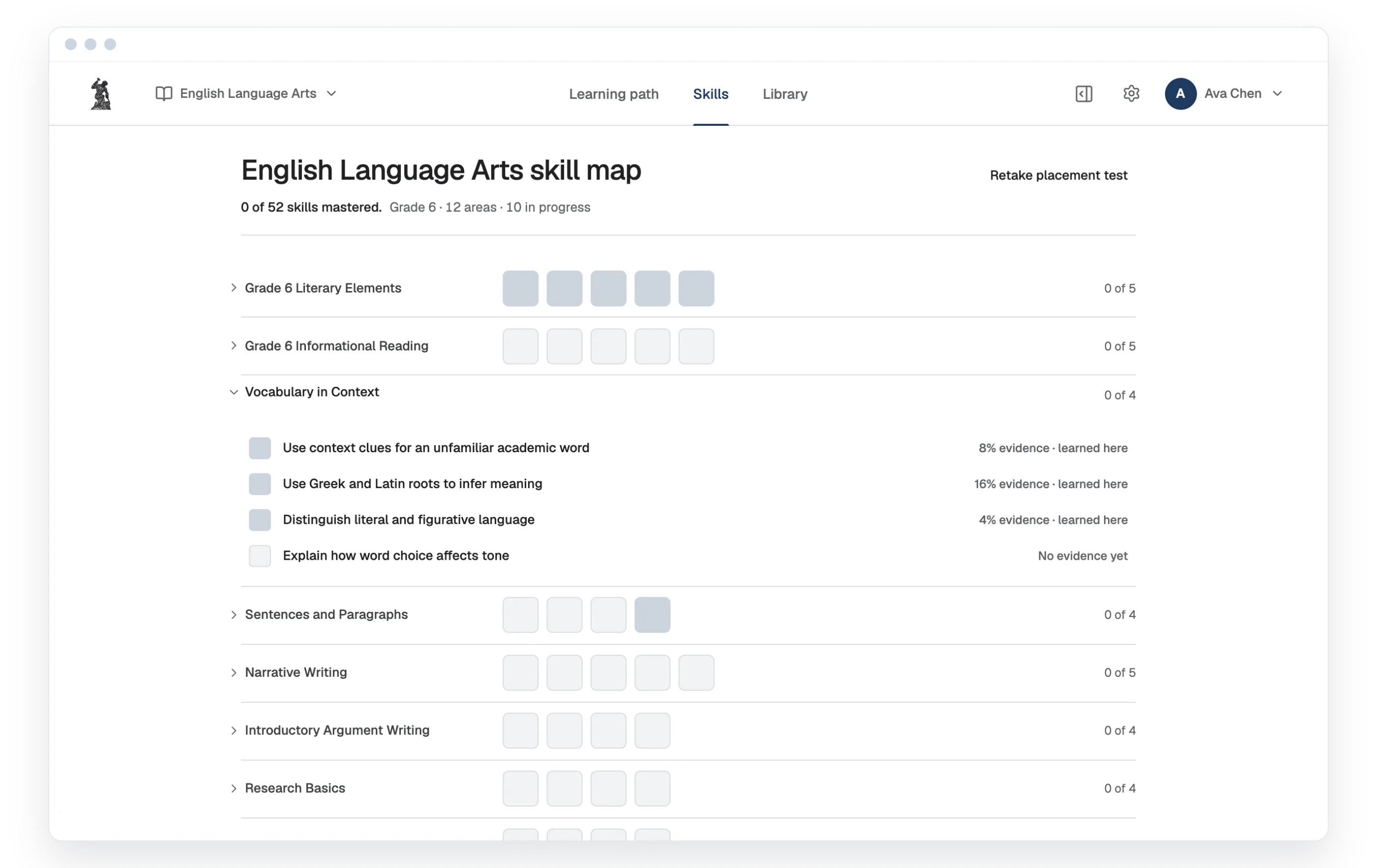
The skill map shows every skill in a course and how much evidence your teen has shown for each. If a starting point turns out wrong, your teen can retake placement from the same page. A retake keeps the work your teen already finished.
A school day for a high schooler
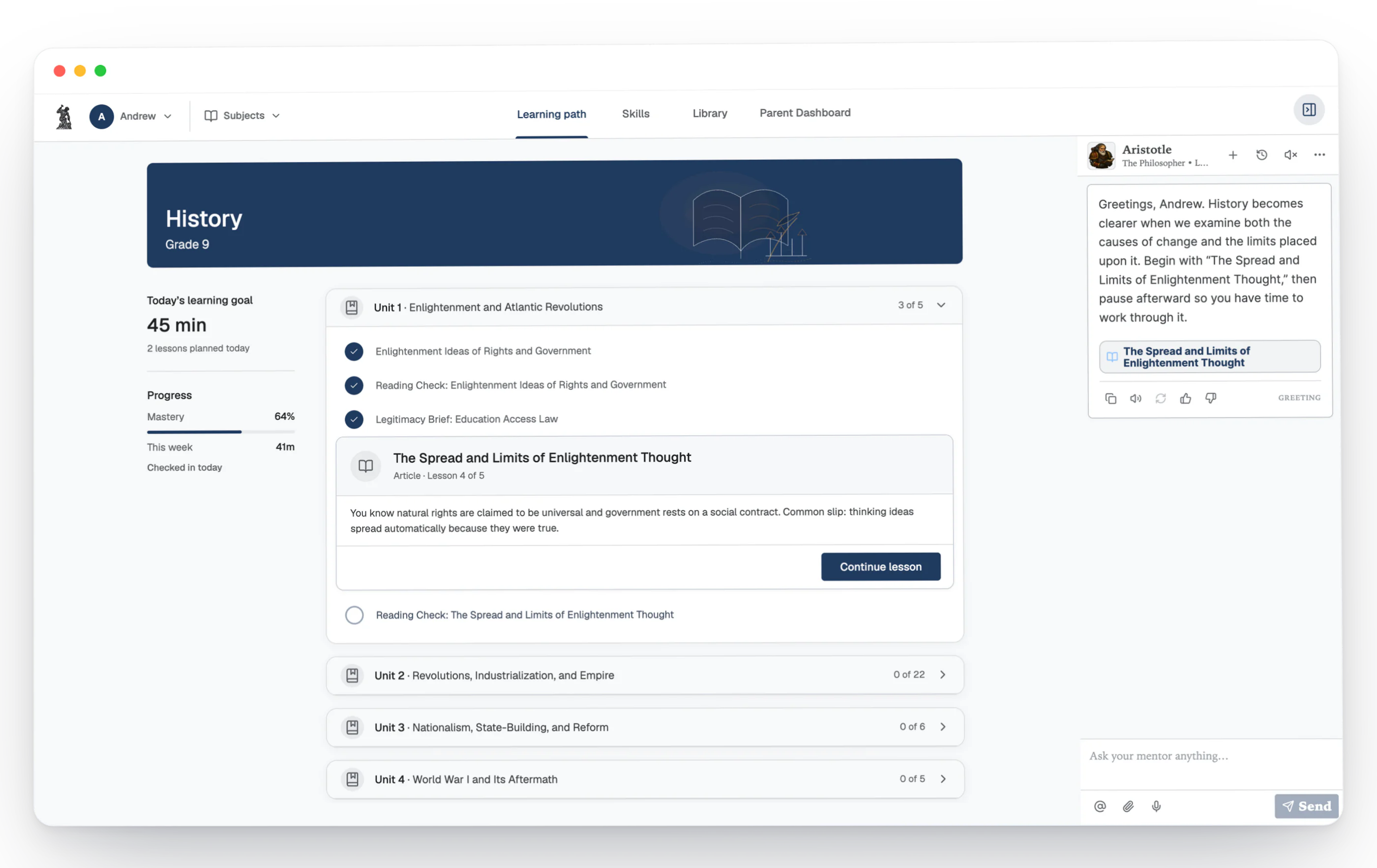
There are no live class times. Your teen signs in, checks in for the day, and opens the next lesson in each subject on their path. The home screen shows today's learning goal in minutes and how the week is going.
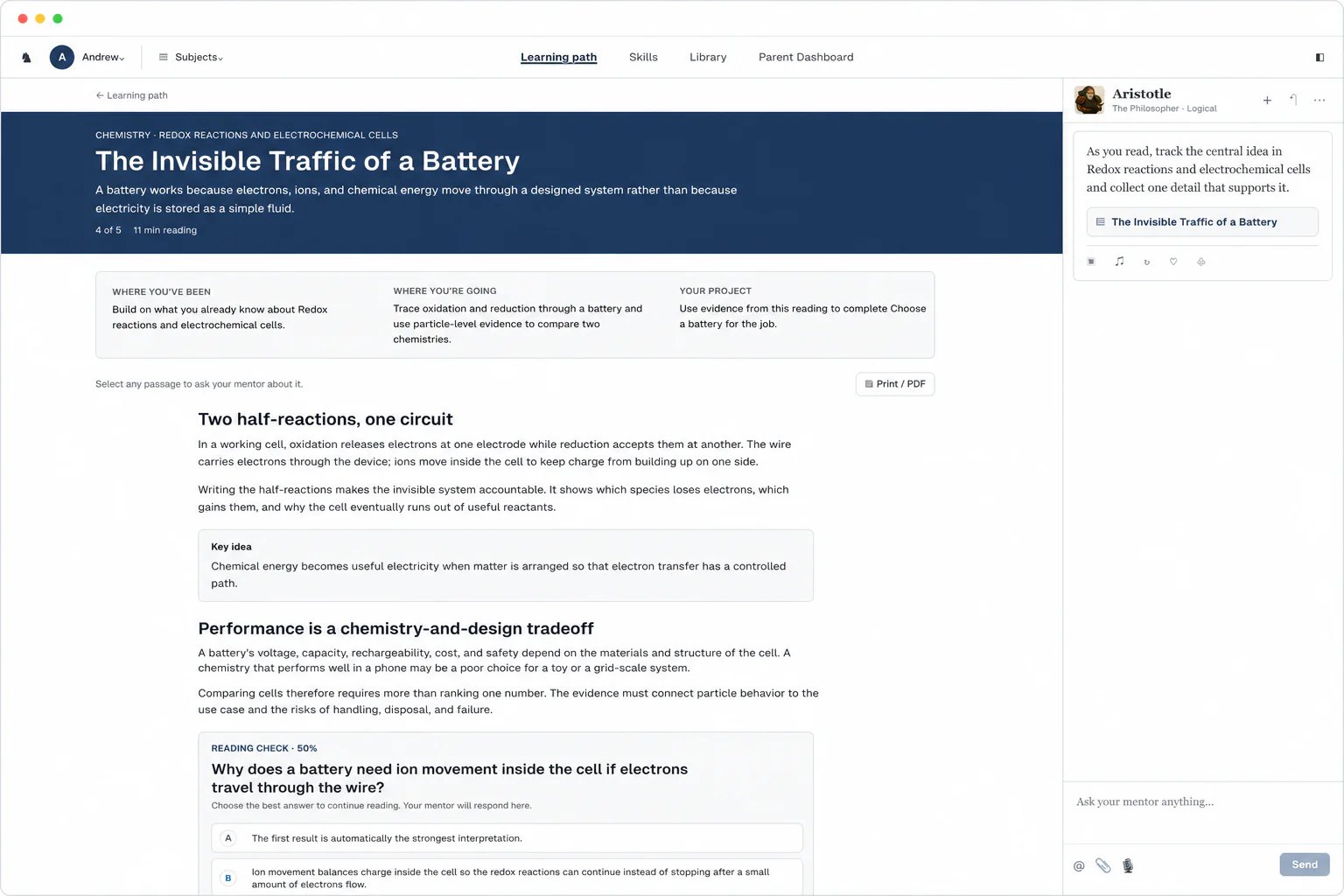
Each lesson is an interactive article written for your teen, with images and videos made for them. The article weaves in your teen's interests. It opens by saying what your teen already knows, where the lesson is going, and which project it leads to, and it shows its reading time.
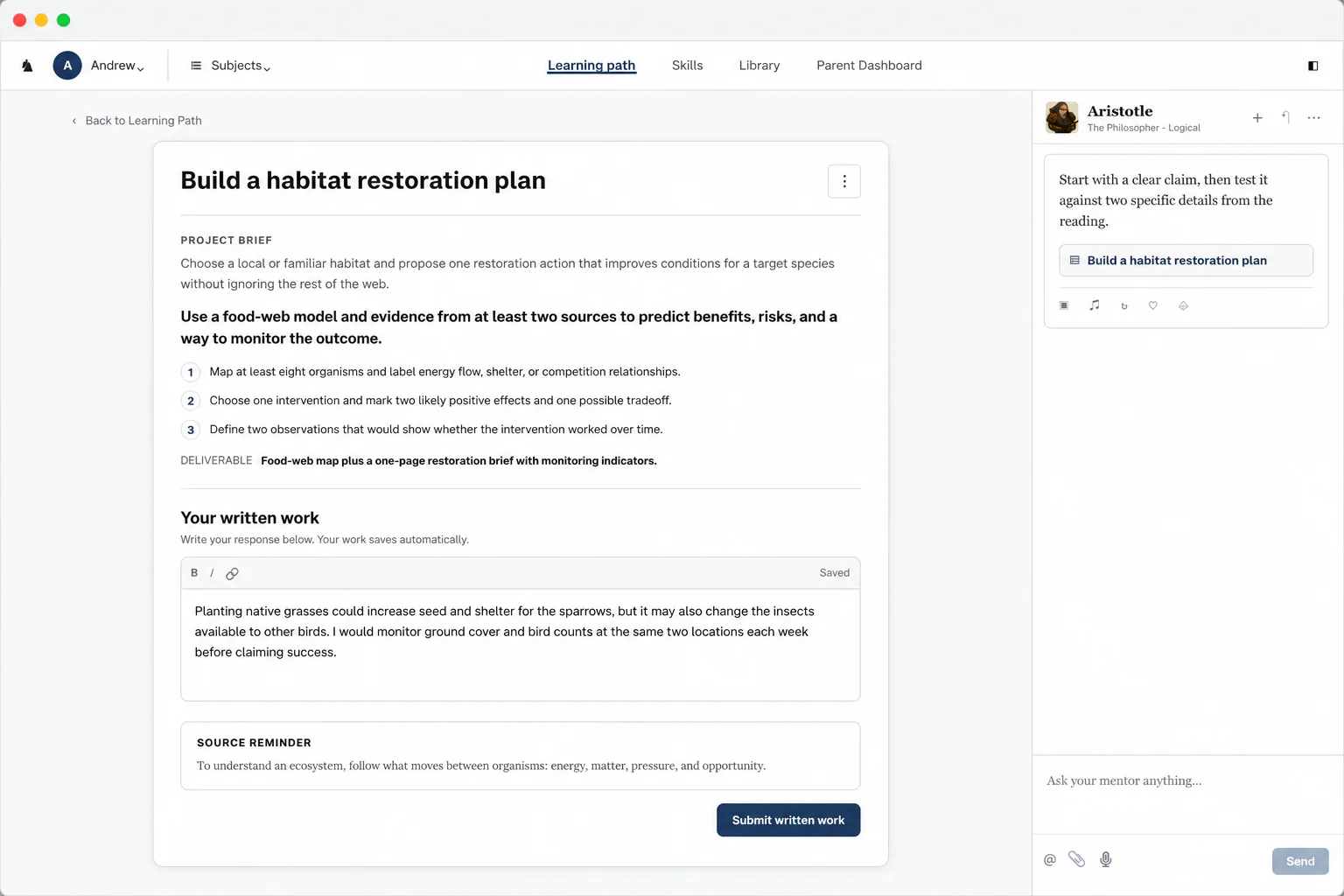
Margin notes connect the idea to earlier lessons, questions throughout push your teen to think ahead, and progress checks along the way make sure each idea holds before the reading check at the end. A project built on the article then puts the idea to real use, and every unit builds to benchmarks.
Our Always-On Mentor, the guide inside each course, stays open while your teen works. Your teen can highlight any passage to ask about it, hear a word pronounced, or have the mentor draw it as a diagram on its board.
The mentor offers help on its own when it looks like your teen is having a hard time, explains a question another way after a wrong answer, guides them through projects without writing the answer, and answers clarifying questions during reading checks without giving the answer away.
On a hard problem, your teen and the mentor go back and forth until the idea is understood.
Notes a teen can study from
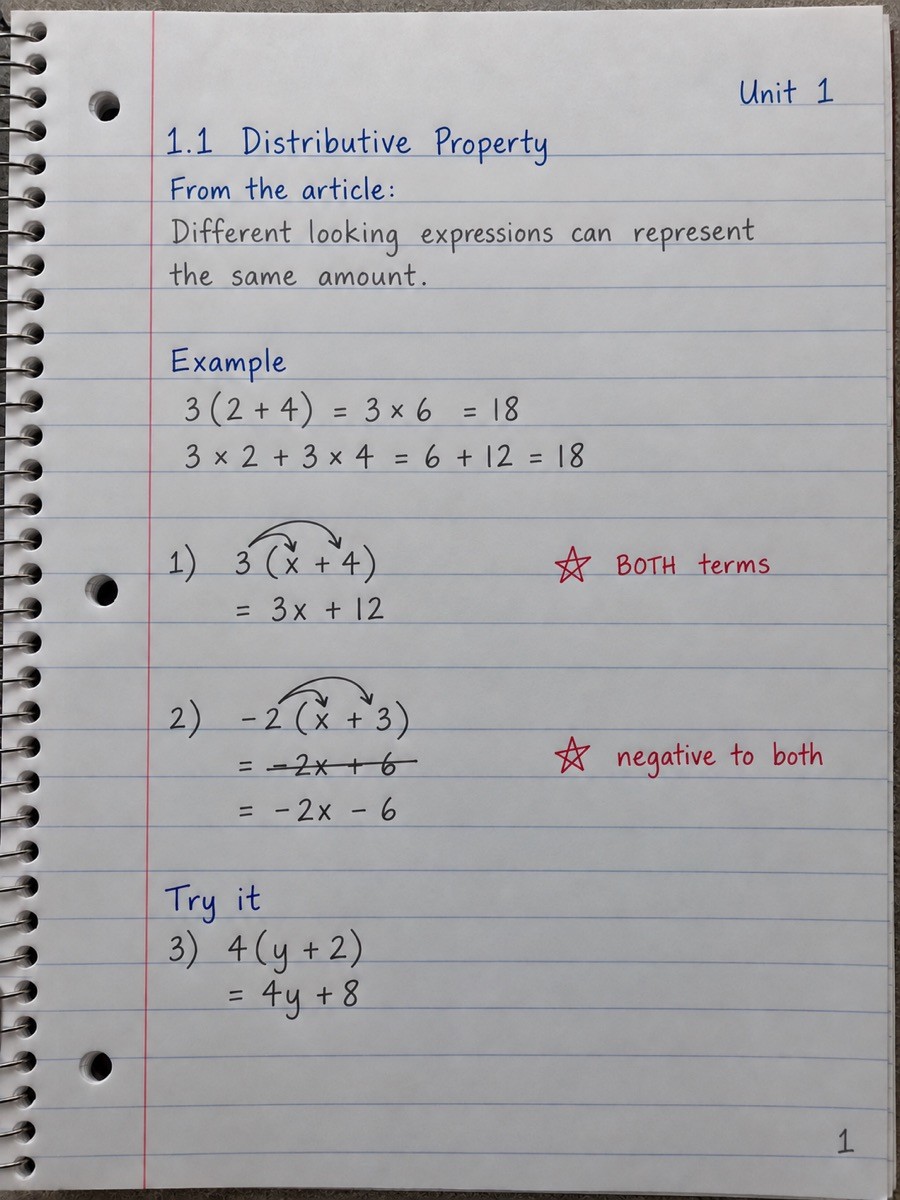
From Grade 3, every reading includes an optional notebook guide with tips for keeping useful notes. It encourages your teen to add lesson headings and unit names and put ideas into their own words, so they can return to a worked example or a question later.
The printable guide offers ways to gather notes into a review sheet, including starring an idea worth remembering. Your child can scan and upload notebook pages to save their takeaways. Takeaways from places they struggled can also shape later practice problems.
How the work is graded
We grade everything your teen submits as soon as they submit it, so grading never lands on you. When your teen gets something wrong, we help them work through it, and projects come back with feedback they can revise from.
Our Parent Dashboard shows the work behind each grade, alongside attendance and progress across subjects. Records ready for your signature appear with other items that need your attention.

How credits are counted
We count credits from the time each subject actually took. We estimate each completed lesson's instructional hours from its length and difficulty, then add up each subject's hours for the school year, which runs July to June.
One credit is 120 hours, the common standard for a full-year course, so 60 hours is half a credit. A subject with fewer than 15 hours in a year shows no credit yet, so a course your teen only sampled does not appear as a credit on the transcript.
Attendance comes from the same day. Your teen checks in once, their activity keeps the session open, and the attendance log fills itself. If your state asks for days or hours of instruction, the record is already there.
How we build the transcript
In our Parent Dashboard, the document tools hold the transcript. We generate it as a PDF from your teen's record, and you can regenerate it any time as the year goes on. It carries:
- Your teen's name, date of birth, address, and graduation date.
- Each school year, with every course, its credits, and its grade. A course's grade is the average of its graded work.
- The grading scale, total credits, and two GPAs: unweighted on a 4.0 scale, and weighted, where each advanced course adds a point.
- A signature line for you as the homeschool's administrator.
Three more documents sit beside it. Course descriptions list, for each course, how many lessons your teen completed, the recorded hours, and the topics covered. The school profile describes your homeschool for an admissions office. The diploma carries your homeschool's name and is ready for your signature.
Export records puts the transcript and the rest of the record in one download.
Work your teen did somewhere else stays on that school's or college's own transcript. Colleges read it alongside ours, so earlier public school credits and dual enrollment courses still count.
Advanced courses and AP exams
Our 40 advanced courses follow the College Board's AP course frameworks, from biology and calculus to art history and Latin. Each one covers the framework's topics, assigns the kind of work the course calls for, and practices questions in the exam's format.
The AP exam itself is given by schools, not by any curriculum. Your teen takes it at a local school that offers AP exams: the College Board's AP Course Ledger lists them by city, and the school's AP coordinator can add a homeschooled student. Ask early in the school year, because exam orders close in mid-November for May exams. Our AP homeschool curriculum page lists every advanced course.
SAT, ACT, and the PSAT
Our SAT prep and ACT prep courses run like any other subject, starting at your teen's level. For the tests themselves, your teen registers online with the College Board or ACT and tests at a test center, with no school involved. When the SAT form asks for a high school code, homeschoolers enter 970000.
The PSAT/NMSQT, the version that qualifies students for National Merit Scholarships, is given at schools. A homeschooled student tests as a visitor: contact a participating school at least four weeks before its testing window.
A common rhythm is a practice PSAT in 9th or 10th grade, the PSAT/NMSQT in the fall of 11th grade, a first SAT or ACT in the spring of 11th grade, and a retake in the fall of 12th grade.
Dual enrollment
Dual enrollment means taking college courses during high school, usually at a community college, for both college and high school credit. The college handles admission, placement, and tuition, and the grade arrives on the college's own transcript, which carries extra weight because an outside instructor gave it.
Cost depends on the state. Florida law exempts dual enrollment students, home education students included, from registration, tuition, and lab fees. Georgia's program covers tuition, mandatory fees, and books at participating colleges. North Carolina's Career and College Promise is tuition-free for eligible juniors and seniors from registered homeschools. In Texas, families arrange dual credit with the college directly. Our dual enrollment guide covers every state.
Playing college sports
A teen who hopes to play Division I or II sports needs an Academic and Athletics Certification account with the NCAA Eligibility Center. The NCAA asks the parent to complete and sign a homeschool administrator statement first, then a core-course worksheet for each core course. Division I requires a 2.3 GPA in core courses and Division II a 2.2.
Our transcript and course descriptions supply what those worksheets ask about: each course, its year, its credits, and what it covered. Start the account by 10th grade so nothing waits on paperwork.
Senior year and applying to college
Colleges read a homeschool application like any other: the transcript, course descriptions, test scores where the college asks for them, and recommendations. Because our transcript fills in as each year's work is done, senior year starts from a finished record, not a rebuild.
- Late summer: generate the transcript and course descriptions through 11th grade, and settle the college list.
- Early fall: schedule any SAT or ACT retake, and ask adults outside the family, such as a coach, an employer, or a dual enrollment instructor, for recommendations.
- By October 1: the FAFSA opens for the next school year; many colleges set aid deadlines before their admission deadlines.
- November: early decision and early action deadlines usually fall between November 1 and 15.
- January: regular decision deadlines usually fall in early January; regenerate the transcript with fall grades for the mid-year report.
- May and June: most colleges ask for a decision by May 1; generate the final transcript and diploma once the last courses finish.
When an application asks the school for a counselor report, you answer it as the homeschool's administrator, and the school profile we generate covers how your homeschool runs. Our college admissions guide goes through each document.
Graduation and the diploma
In most states the homeschool issues the diploma, and it is a legitimate diploma when the homeschool followed state law. We generate it with your homeschool's name and your teen's graduation date, ready for your signature. Your teen graduates when they finish the courses you agreed on, which does not have to be in May.
A homeschool graduate does not need a GED for most colleges or for federal student aid: finishing a homeschool program that state law treats as a home school or private school meets the aid rules.
Frequently asked questions
- Does my teen need a world language for college?
- For most four-year colleges, yes: plan on two years of one language, and three or four for selective colleges. The University of California requires two and recommends three.
- Can a homeschooler graduate early?
- Yes, in most states, once your teen finishes the courses you set. Check whether the colleges on their list expect four years of core courses, and how an early finish affects NCAA timelines for athletes.
- Can I homeschool high school if I am not good at math or science?
- Yes. We teach every course, so you never explain Algebra 2 yourself, and the mentor works through each step with your teen on its board.
- Is it too late to start in 11th grade?
- No. Credits already earned stay on the old school's transcript, and our transcript picks up from the first year with us. Placement starts each remaining course where your teen is.
High school, run for you
In the first week, your teen's placement results show where each high school course begins.
$149/month per child after the trial.