Most states let the homeschool set graduation requirements. Here are the states that list courses, what colleges expect, and how our courses meet them.
Who sets graduation requirements
Three layers decide what a homeschooled teen takes before graduating. State law comes first, and for most states it is short: a list of subjects a homeschool must teach, with no credit count.
Texas, for example, treats a homeschool as a private school, asks it to cover reading, spelling, grammar, math, and good citizenship, and leaves graduation requirements to the parent. Our Texas graduation guide covers that state in detail.
Inside the law, the homeschool sets its own rules, the way any private school does. Then the goal after graduation adds a third layer: colleges, the NCAA, and some training programs publish the courses they expect. For most families, the college layer is the one that decides the real requirements.
States that set high school courses
A few states spell out what a homeschool's high school years must include.
- Pennsylvania sets minimum courses in grades 9 to 12 for a home education diploma: four years of English, three of math, three of science, three of social studies, and two of arts and humanities. State guidance adds health, physical education, and electives, and says graduation should rest on completed courses and the state's standards rather than a credit count.
- New York asks for these units across grades 9 to 12: four of English; four of social studies, including American history, a half unit of participation in government, and a half unit of economics; two of math; two of science; one of art or music; a half unit of health; two of physical education; and three electives.
- California homeschools teach the subjects public schools teach, adding a foreign language, applied arts, and career technical education in grades 7 to 12.
- Maine asks for Maine studies in one grade from 6 to 12 and a show of computer proficiency in one grade from 7 to 12, and South Carolina adds composition and literature in grades 7 to 12.
Everywhere else, the state's list of required subjects is the whole legal requirement. Our requirements checker shows your state's list.
States where completion is shown another way
Three large states treat the end of homeschool high school differently from the rest. Pennsylvania recognizes a parent-awarded diploma on the state's own form, co-signed by the evaluator who completed the 12th-grade evaluation. Florida issues no diploma for home education; the parent's notarized affidavit that the program is complete is the legal proof.
New York does not award home-instructed students a diploma, but the district superintendent can certify in writing that the program was substantially equivalent to four years of high school, which colleges accept.
Our guide to the homeschool diploma explains each route and how we generate the diploma everywhere else.
What colleges and the NCAA expect
College admission is where the real course list comes from. The common college-prep pattern is about four years of English, three or four of math, three or four of science, three or four of history and social studies, two years of one world language, and a year of the arts, for 24 to 28 credits in all. Selective colleges often look for three or four years of a language.
Published rules make it concrete. The University of California asks for 15 yearlong courses: two years of history, four of English, three of math including geometry, two of science, two of one language other than English, one of visual or performing arts, and one elective, with a fourth year of math and a third of science and language recommended.
For a teen who hopes to play Division I sports, the NCAA requires 16 core courses: four years of English, three of math at Algebra 1 or higher, two of science, one more of English, math, or science, two of social science, and four more core courses, with at least a 2.3 GPA in them.
How our courses cover the list
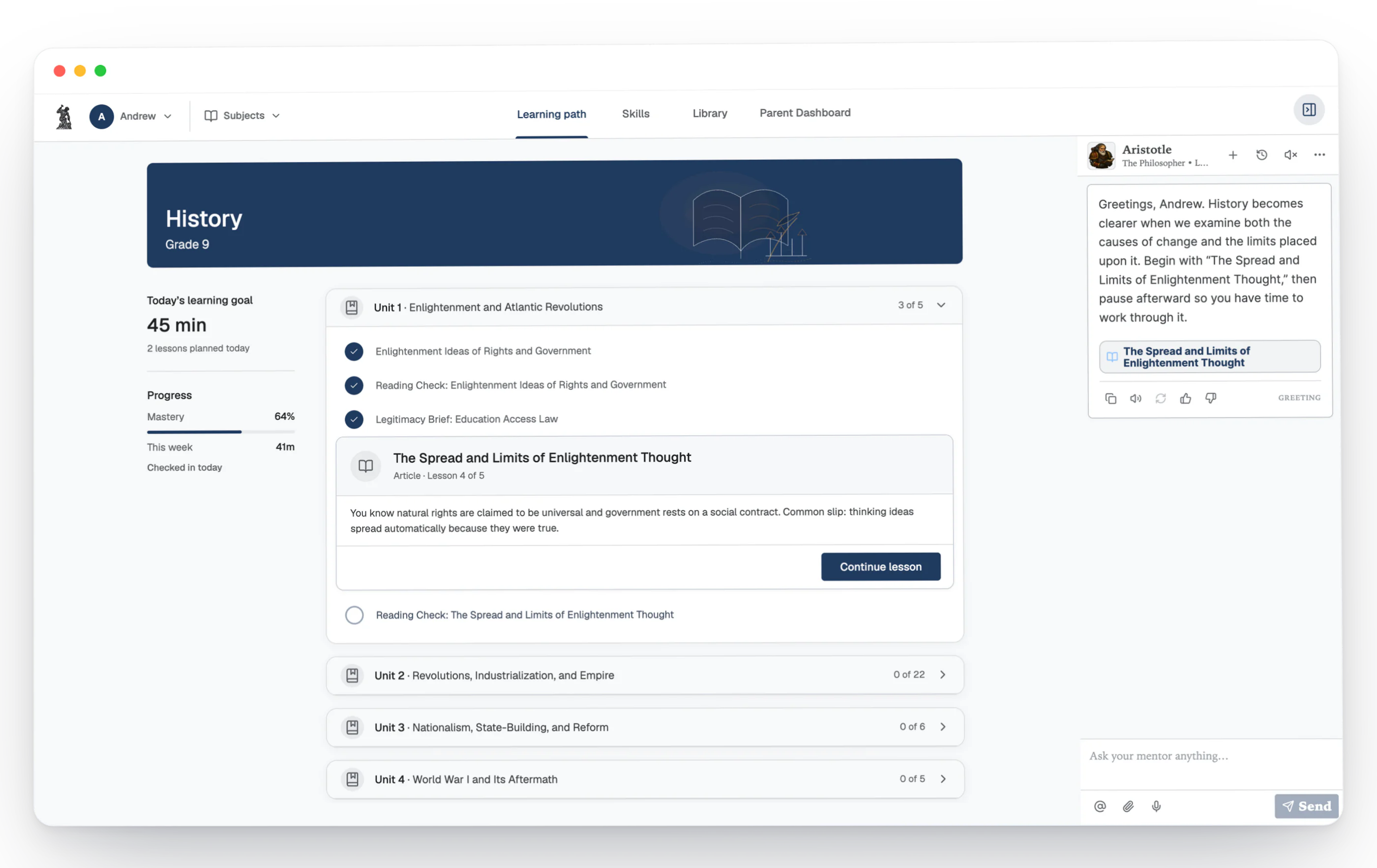
Your teen takes every high school course with TheHomeschoolingCompany.com. Most high schoolers use School in a Box, our full plan, which runs up to 12 subjects at once, so a full college-prep year fits with room to spare. The catalog maps onto every requirement above:
- English: English language arts, plus communications.
- Math: algebra, geometry, pre-calculus, calculus, and statistics.
- Science: biology, chemistry, and physics, plus astronomy, earth science, and materials science.
- Social studies: history, US citizenship and civics, political science, economics, geography, psychology, and philosophy.
- World languages: Spanish and Italian, and advanced courses in Chinese, French, German, Italian, Japanese, Latin, and Spanish.
- Arts, health, and physical education, plus electives such as computer science, engineering, finance, and law, or a custom elective on any topic.
Every subject your teen keeps active in a school year becomes a line on the transcript for that year. So meeting Pennsylvania's list, New York's units, or the University of California's pattern means keeping the matching subjects active each year.
How a year of work becomes a credit
We count credits from the time each course actually took. Each completed lesson's instructional hours are estimated from its length and difficulty, and a subject's hours for the school year, July to June, are divided by 120, the common standard for one credit. So 120 hours is one credit and 60 hours is half. A subject with fewer than 15 hours in a year shows no credit.
The transcript is the running count. Generate it in the document tools at any point, and it shows every course by year with its credits and grade, the total credits, and both GPAs, so you can see at a glance which requirements are met and which are still in progress.
When a teen is ahead or behind
Requirements are counted in courses, but teens rarely arrive even across subjects. Placement, the short adaptive test in each subject, starts every course at the skills your teen is ready for, from two grades below to two grades above their grade.
A teen who is ahead in math can reach calculus early, and one who is behind in writing fills the gap first instead of failing a course built for someone else.
Because each course moves as your teen shows the skills, a teen can finish the requirements early and graduate when they are done. Our Always-On Mentor helps along the way: it answers questions about any passage, explains a problem another way after a wrong answer, draws ideas on its board, and guides projects without giving the answer.
Frequently asked questions
- Can my teen cover physical education and health?
- Yes. Physical fitness and health are subjects in our catalog, with lessons and projects, so they earn credits like any course.
- Which world languages can meet a two-year requirement?
- Two years of Spanish or Italian meets the common college expectation, and a teen can go on to the advanced course in either one.
- Do I need to file a graduation plan with the state?
- Not in most states. New York's yearly home instruction plan lists each subject's materials, and Pennsylvania's affidavit includes education objectives by subject; we draft both.
Every requirement, taught and counted
Choose the courses your teen's goals call for, and each finished year adds its credits and grades to the transcript.
$149/month per child after the trial.