In most states the homeschool issues its own diploma. We generate yours, with the transcript behind it, and explain the states that do it differently.
How we make the diploma
A diploma is one page, but it rests on four years of work, and that work is what we spend high school building. Your teen's coursework here supplies that record. We grade everything your teen submits as soon as they submit it, so grading never lands on you.
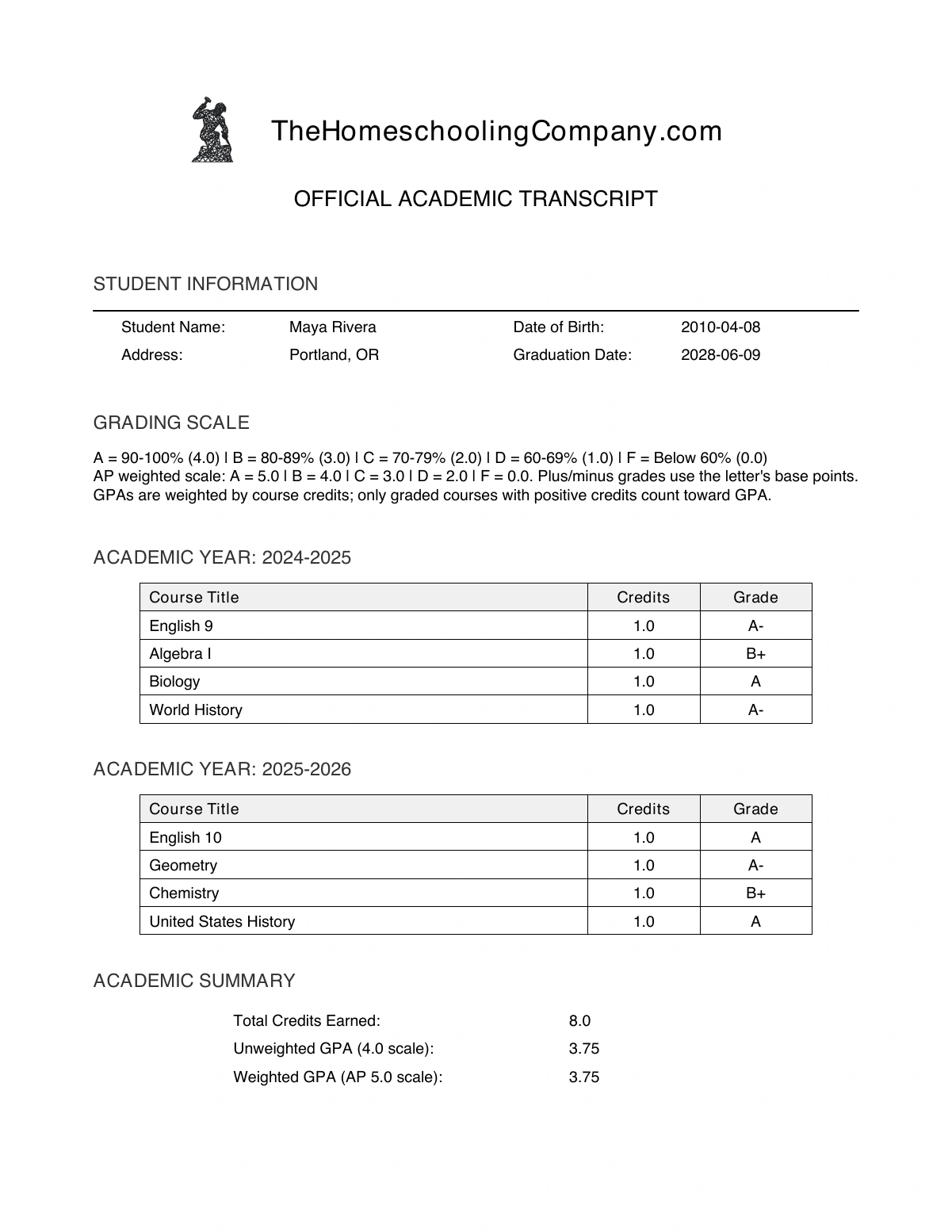
Hours become credits and graded work becomes course grades, so the record behind the diploma fills in as your teen learns.
Help is part of every course. Our Always-On Mentor works beside each lesson and project: it answers questions about any passage, explains an idea another way after a wrong answer, draws it step by step on its board, and guides projects without writing them, so the work behind the diploma is your teen's own.
When your teen finishes, open the document tools, your private view of each child's work and documents, and generate the diploma. It carries your homeschool's name, your teen's name, the graduation statement, and a signature line for you as administrator.
The transcript, course descriptions, and school profile come from the same page, so the diploma and the documents that support it always agree.
Who issues a homeschool diploma
In most states, the homeschool is the school, and a school issues its own diploma. Texas, for example, treats a homeschool as a private school, so parents set the graduation requirements and award the diploma. Tennessee asks the homeschool to create and hold its own grades and transcripts, including copies of any diploma it issues. A few states handle it differently, and the difference matters:
- Pennsylvania recognizes a diploma awarded by the parent on the state's own form, PDE 6008, co-signed by the evaluator who completed your teen's 12th-grade evaluation. The state also approves home education associations that grant diplomas. Use the state form for that recognized diploma; our transcript and course descriptions are the record behind it.
- Florida issues no diploma for a home education program. The legal proof of completion is a notarized affidavit from the parent saying the program is complete, and that statement can also appear on the transcript or a parent-issued diploma.
- New York does not let a home-instructed student receive a Regents or local diploma. For college, the school district superintendent can certify in writing that the program was substantially equivalent to four years of high school. A student past compulsory school age can instead complete 24 college credits in set subjects or earn a high school equivalency diploma.
- Church school and umbrella routes, such as Alabama's, follow that school's own policies for graduation.
What your teen needs to graduate
Most states let the homeschool set its own graduation requirements, within the subjects its law lists. Pennsylvania is the clearest exception: for its diploma, a teen needs at least four years of English, three of math, three of science, three of social studies, and two of arts and humanities in grades 9 to 12.
Colleges usually expect more than any state does: about four years of English, three or four each of math, science, and history and social studies, two years of one world language, and some arts.
That pattern is the set of subjects your teen keeps active each year in School in a Box, our full plan with up to 12 subjects at once. Each one becomes a line on the transcript, and a teen aiming at engineering, for example, keeps math and physics going every year. Our guide to graduation requirements by state has the details.
Will colleges, employers, and financial aid accept it?
Colleges admit homeschool graduates with parent-issued diplomas every year. They read the transcript behind the diploma, and test scores where they ask for them, more closely than the diploma itself. Some ask homeschool applicants for more evidence than other applicants, such as SAT or ACT scores or course descriptions, and we generate the course descriptions from the same record.
Federal student aid does not require a GED. The Department of Education treats a student as eligible when their secondary education was in a homeschool that state law treats as a home school or private school. Where a state issues its own completion credential to homeschoolers and requires it, the student needs that credential.
The GED is a different credential
A GED or other high school equivalency diploma is earned by passing an exam, not by finishing a school program. A homeschool graduate does not need one for most colleges or for federal aid.
Some families still choose it where it helps: in Florida, a student who passes the GED at an education center receives a GED diploma from the state, and in New York it is one route for a student past compulsory school age.
If your teen is working toward an equivalency exam, our courses in English language arts, math, science, and history cover the same ground, starting at the level placement finds in each subject.
When your teen graduates
Your teen graduates when they finish the courses your homeschool set, which does not have to be in May or after exactly four years. Because each course moves as your teen shows the skills, some finish a subject early and some take longer, and the transcript records whatever the hours and grades actually were.
The graduation date on the transcript and the diploma is the one you set.
For an athlete aiming at college sports, check the NCAA's timing before an early finish: Division I requires 16 core courses, with 10 of them, 7 in English, math, or science, finished before the seventh semester of high school. Many families mark the day with their own ceremony, and the printed diploma is ready for it.
If your teen started high school somewhere else
Credits your teen earned at a public or private school, or through dual enrollment, stay on that institution's transcript. Our transcript begins with their first school year here, and colleges read both together. The diploma comes from your homeschool, because that is the school your teen finishes.
Placement, the short adaptive test in each subject, starts every remaining course where your teen actually is, so a teen who arrives in 11th grade does not repeat what they already know or skip what they missed.
Frequently asked questions
- Does a homeschool diploma need a seal or a notary?
- Not in most states. Florida's proof of completion is a notarized affidavit, and Pennsylvania's recognized diploma needs the evaluator's co-signature on the state form.
- Does our homeschool need a name for the diploma?
- Some states already ask for one: Kentucky and North Carolina homeschools are named when they file. Elsewhere you choose a name, and it appears on the diploma and the transcript.
- What if the diploma is lost years later?
- Generate it again from the document tools. In Pennsylvania only the original 12th-grade evaluator can co-sign a replacement state diploma, so families there keep the signed original safe.
Four years of record, then a diploma to sign
Every course your teen finishes adds its credits and grade, so graduation day starts with the paperwork already done.
$149/month per child after the trial.
Sources (5)
- Pennsylvania Department of Education: home education and private tutoring
- Florida Department of Education: home education parent FAQ
- New York State Education Department: home instruction and the preliminary education requirement
- Federal Student Aid Handbook 2026-27: school-determined requirements
- Texas Education Agency: home schools