The Socratic method is teaching by questions. Instead of explaining a conclusion, the teacher asks what the student thinks, why, and what follows from it. The student does the reasoning, and the teacher steers it.

Where the method comes from
Socrates, who taught in Athens in the fifth century BC, wrote nothing down. We know his way of teaching from the dialogues his student Plato wrote, in which Socrates asks someone to define an idea and then tests the definition with cases.
In the dialogue called Laches, two Athenian generals try to say what courage is. Laches first says a brave man stays at his post and fights. Socrates points to horsemen who fight while retreating, so Laches widens his answer to "a sort of endurance of the soul." Socrates then asks whether foolish endurance counts as courage, since courage is supposed to be admirable. The second general, Nicias, tries "knowledge of what is to be feared," and that runs into trouble too. The dialogue ends with Socrates admitting that none of them has found what courage is. A conversation at home does not need to end that way, but the pattern of definition, counterexample, and revision is the same.
Five kinds of follow-up
Good Socratic questions fall into a few kinds. Each one has a job.
- Clarify: What do you mean by that? Can you give an example?
- Probe assumptions: What are you taking for granted here?
- Ask for evidence: How do you know? What would change your mind?
- Test a consequence: If that is true, what else must be true?
- Consider the other side: What would someone who disagrees say?
The teacher does not need to know where the student will land. The goal is for the student to find the weak spot in their own thinking and fix it.
A short example: what makes someone brave
A child says a character was brave because they were not afraid. You might ask whether a person who feels afraid can still act bravely. If the child thinks so, they need a definition that includes both cases. Returning to the story, they can point to what the character risked and explain whether that supports the revised definition.
The same moves in math, science, history, and writing
- Math. A child says multiplying always makes a number bigger. What is 6 × ½? What is 6 × 0? The child revises the rule: multiplying a positive number by something greater than 1 makes it bigger, and multiplying by a fraction between 0 and 1 makes it smaller.
- Science. A child says heavier things fall faster. Drop a flat sheet of paper and an identical sheet crumpled into a ball. They weigh the same, yet the ball lands first, so weight alone cannot be the explanation, and air resistance enters the conversation.
- History. A soldier's letter calls a battle a great victory. Who was he writing to? What might he leave out? What would a letter from the other side say?
- Writing. A draft claims that social media is bad. Bad for whom, and compared with what? What would a grandparent who uses it to see photos of grandchildren say? The thesis usually gets narrower and stronger.
What it looks like at 6, 10, and 15
At 6, one or two follow-ups about something the child can see or hold is plenty. "How do you know the bigger cup has more water? What could we do to check?" Pouring each into one of two identical glasses answers it, and the child learns that a claim can be tested.
At 10, children can handle definitions and counterexamples, as in the bravery and multiplication examples. They enjoy finding the case that breaks a rule, including an adult's rule.
At 15, the questions can move to assumptions and consequences. A teenager arguing that the voting age should be lowered can be asked what a voter needs to understand, whether most 16-year-olds understand it, and what else should change if they do. The same student can then write the strongest objection into their own essay and answer it.
What the exchange reveals
A child who is told an answer can repeat it. Working through a question can show whether the learner can use the idea in a new case. A follow-up may uncover a gap behind a correct answer, while an incorrect answer can reveal which step needs attention. One exchange is evidence to examine, not a perfect test of what a child knows.
The method also builds a habit that lasts: checking your own claims before someone else does.

Imitations of the method
Some conversations have the form of the method without the substance. A leading question such as "Don't you think the character was selfish?" is a statement with a question mark, and the child knows which answer is wanted. A rapid string of yes-or-no questions walks the child to the adult's conclusion without any reasoning of their own. And a chain of ten follow-ups in a row can feel like cross-examination, which teaches a child to stop offering ideas.
The real thing leaves the child room to say something the adult did not expect, and treats that answer as worth testing rather than as a wrong turn.
Know when to explain
If the child cannot remember what the character did, return to that passage before asking whether the action was brave. A question is easier to consider when the relevant facts are in reach. If the child feels they are guessing what the adult wants to hear, invite a different answer and ask what supports it.
One thoughtful follow-up can be enough. Leave time for the child to answer, and offer an explanation when they need new information rather than another question.
How we use it
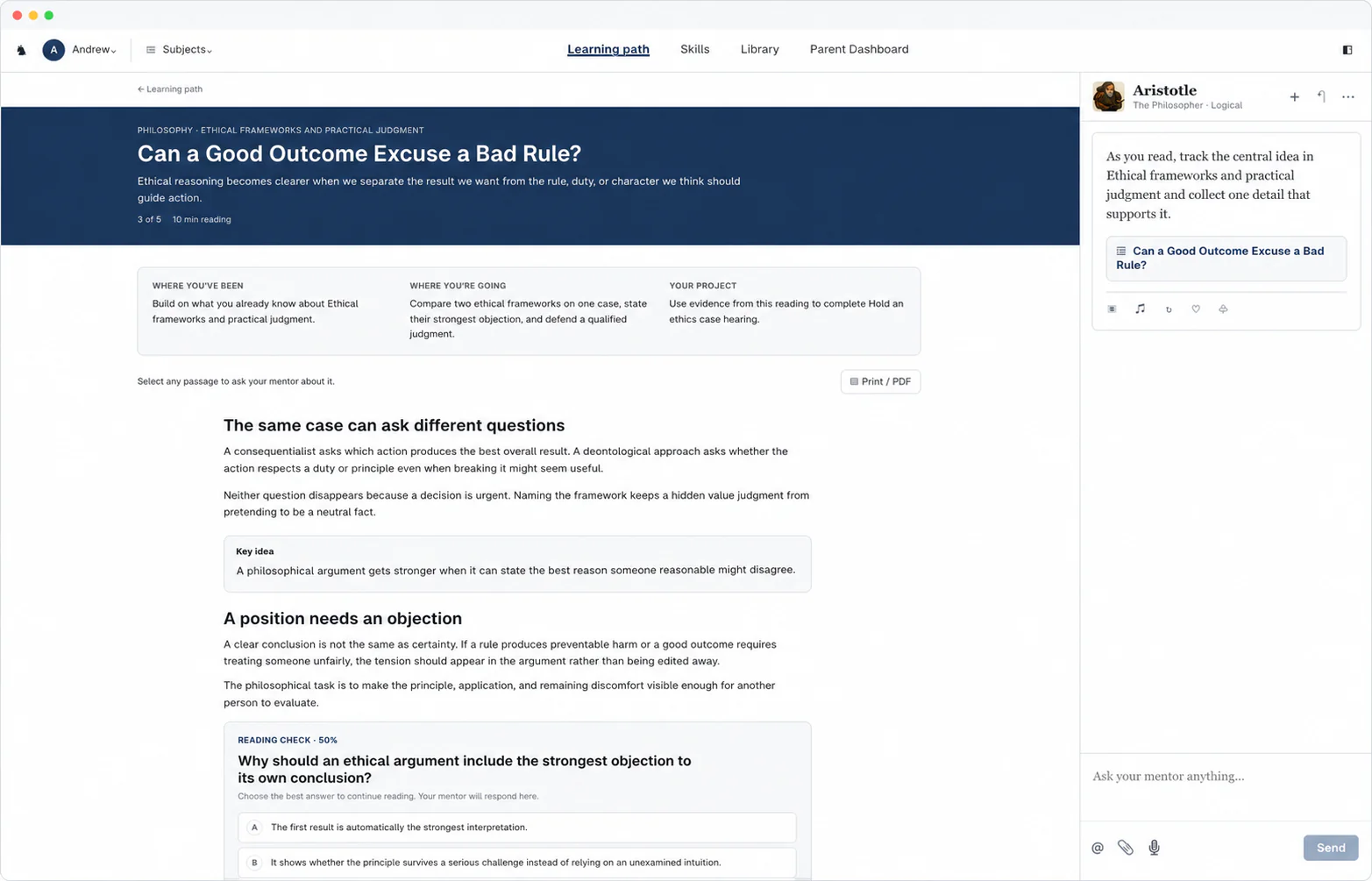
The Always-On Mentor, software that stays open beside every reading and project, works this way on projects: it guides your child through each step without doing the work for them. During a reading check it answers clarifying questions without giving the answer away. When the child lacks the facts, another question will not help, so after a missed answer it can explain the idea another way instead of turning every exchange into a quiz.
That is the method's practical limit. Questions help a learner examine an idea they have some tools to understand; they cannot replace the lesson that supplies those tools.