Philosophy can be a subject in its own right and a habit that runs through the rest of homeschooling. A child learns to ask what a word means, what an argument assumes, and what evidence would change an answer. Those moves carry into science, history, and writing.

What philosophy trains
Most school tasks ask for an answer. Philosophy asks for the reasons behind it. A child who has practiced it learns to separate a claim from the evidence for it, spot an argument that sounds good but does not follow, and state the strongest version of a view they disagree with.
These skills are plain and useful. A student reading a science claim asks what the data actually shows. A student reading a historical source asks who wrote it and what they wanted. A student writing an essay checks that the conclusion follows from the paragraphs above it.
Logic: the tools for testing an argument
Logic gives a child a set of tools: valid and invalid arguments, common fallacies, and the difference between a necessary and a sufficient condition. Each one fits in a single example.
- Valid and invalid. "All mammals breathe air. A whale is a mammal. So a whale breathes air" is valid. "All dogs have four legs. My cat has four legs. So my cat is a dog" has true premises and a false conclusion: plenty of four-legged animals are not dogs, so the conclusion does not follow.
- Necessary and sufficient. Oxygen is necessary for a fire, but not sufficient: the room is full of oxygen and nothing is burning. A child who sees this stops treating "needed for" as "causes."
- Fallacies. "You only say that because you're older" attacks the person instead of the point. "Either we ban phones or kids will never read again" offers two options when there are many.
Ethics: giving reasons for right and wrong
Ethics gives children real questions with no answer key: when is it right to break a promise, what do we owe strangers, is fairness the same as equal treatment. The value is in giving reasons and testing them against a harder version of the same case, which is what the next example does.
Work through one disagreement carefully
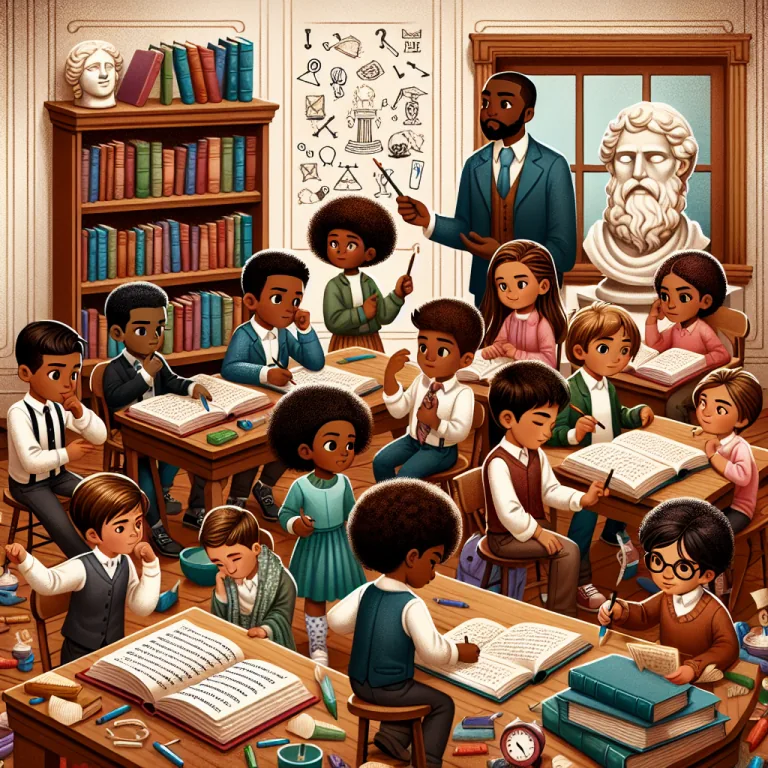
Suppose two children both want the same book. Does fairness mean taking turns, giving it to whoever asked first, or giving it to the person who needs it for an assignment? Changing one detail lets the child examine their own rule. If taking turns is fair, does that still hold when one child has a deadline tomorrow? The discussion has somewhere to go because the disagreement is specific.
Other branches with concrete puzzles
Ethics and logic are the usual starting points, but children take to other parts of philosophy quickly because the puzzles are concrete.
- What makes something the same thing. If every plank of a ship is replaced, one at a time, is it still the same ship? Is a person the same person at 6 and at 60?
- How we know. How do you know you are not dreaming right now? What is the difference between believing something and knowing it?
- Minds. Could a robot feel pain, or only act as if it does? How would anyone tell?
- Rules and power. Who should get to make the rules for a group, and what makes a rule fair to the people who did not vote for it?
What it looks like at 6, 10, and 15
At 6, philosophy is mostly about categories and fairness. Is a hot dog a sandwich? Is a seed alive? Was it fair that the fox in the fable tricked the crow? Fables and short dilemmas are enough; the skill is giving a reason and listening to someone else's.
At 10, children can handle definitions and counterexamples. A child who says "a sport is anything with a ball" can be asked about swimming, and will usually produce a better definition. Logic puzzles and thought experiments hold their attention at this age.
At 15, students can read short primary texts and write their own arguments with an objection and a reply. The Stoic teacher Epictetus begins his handbook with "Some things are in our control and others not," and a teenager facing an exam can test that line directly: preparation is in their control, the exact questions are not. Reading a philosopher this way is practical, not just historical.
What the research shows
Two trials in England tested this directly. In a randomized trial published by the Education Endowment Foundation in 2015, children in 48 schools, aged roughly 8 to 10, had about one session a week of group philosophical discussion for a year. They made about two months of additional progress in reading and math compared with children in the comparison schools. A larger follow-up trial with 198 schools and 10- and 11-year-olds, published in 2021, found no evidence of an effect on reading or math.
The honest reading is that philosophy should be valued for the reasoning itself, not counted on to raise test scores. Teachers in the first trial did report that children became more confident speaking and more patient listening to others, which are the habits the subject sets out to build.
Philosophy needs a conversation partner
A patient partner gives a child room to develop an opinion and then examine it: what do you mean by that, what if the opposite were true, how would you know? A short conversation about one claim can be enough to practice this.
It also builds independence. A child who is used to defending a position becomes less dependent on being told what is right, and more able to study alone, because they know how to check their own thinking.
How we build it into lessons
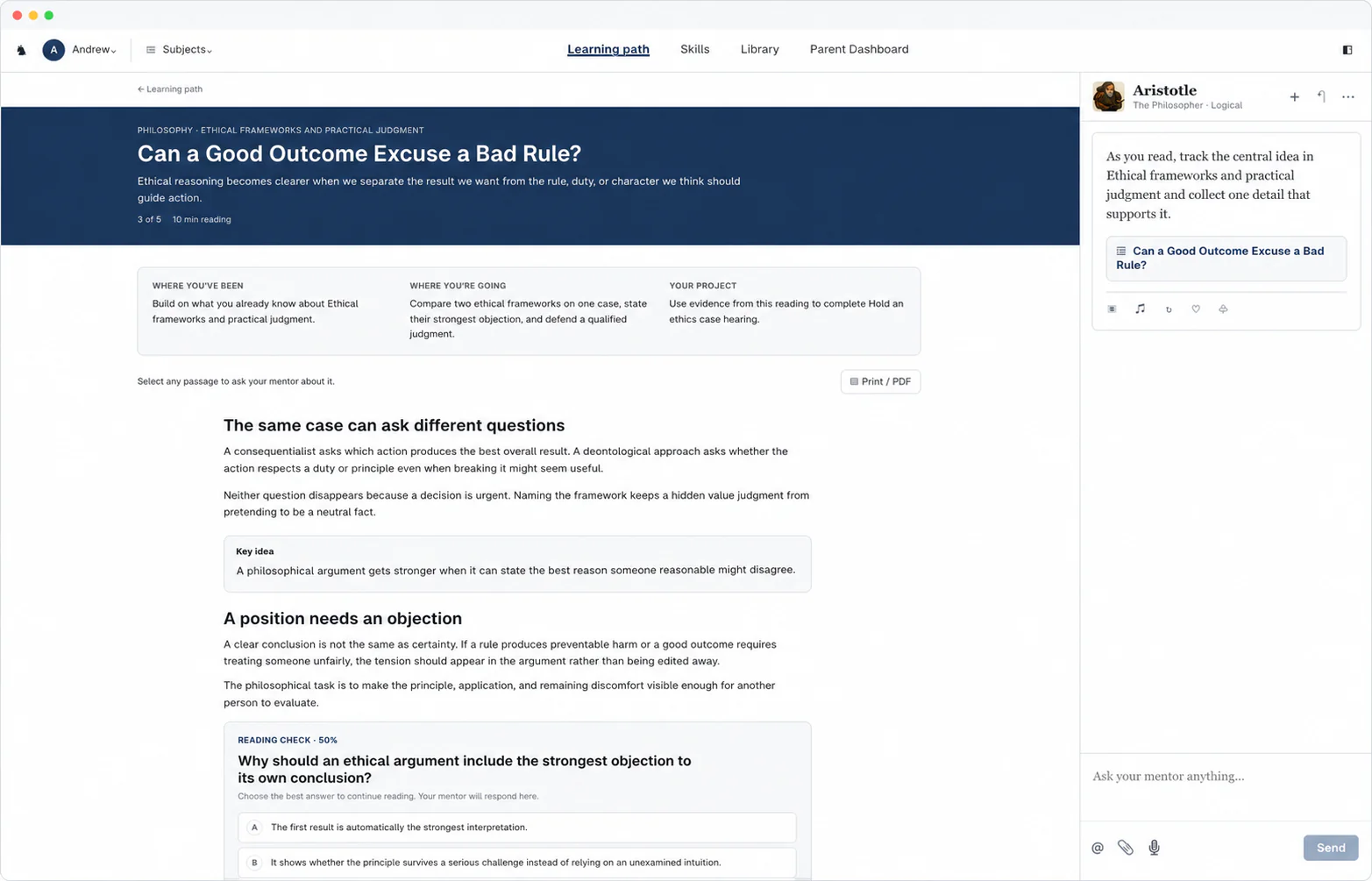
The Always-On Mentor, software that stays open beside every article, is there when a claim confuses your child: they can highlight the passage and ask about it, and the mentor can draw the argument step by step on its board. That help carries into math, reading, science, and history, but the child still needs the facts and concepts to reason about.
We grade everything your child submits as soon as they submit it, so grading never lands on you. The useful habit is not asking questions for their own sake; it is learning to support a claim and revise it when the evidence changes.