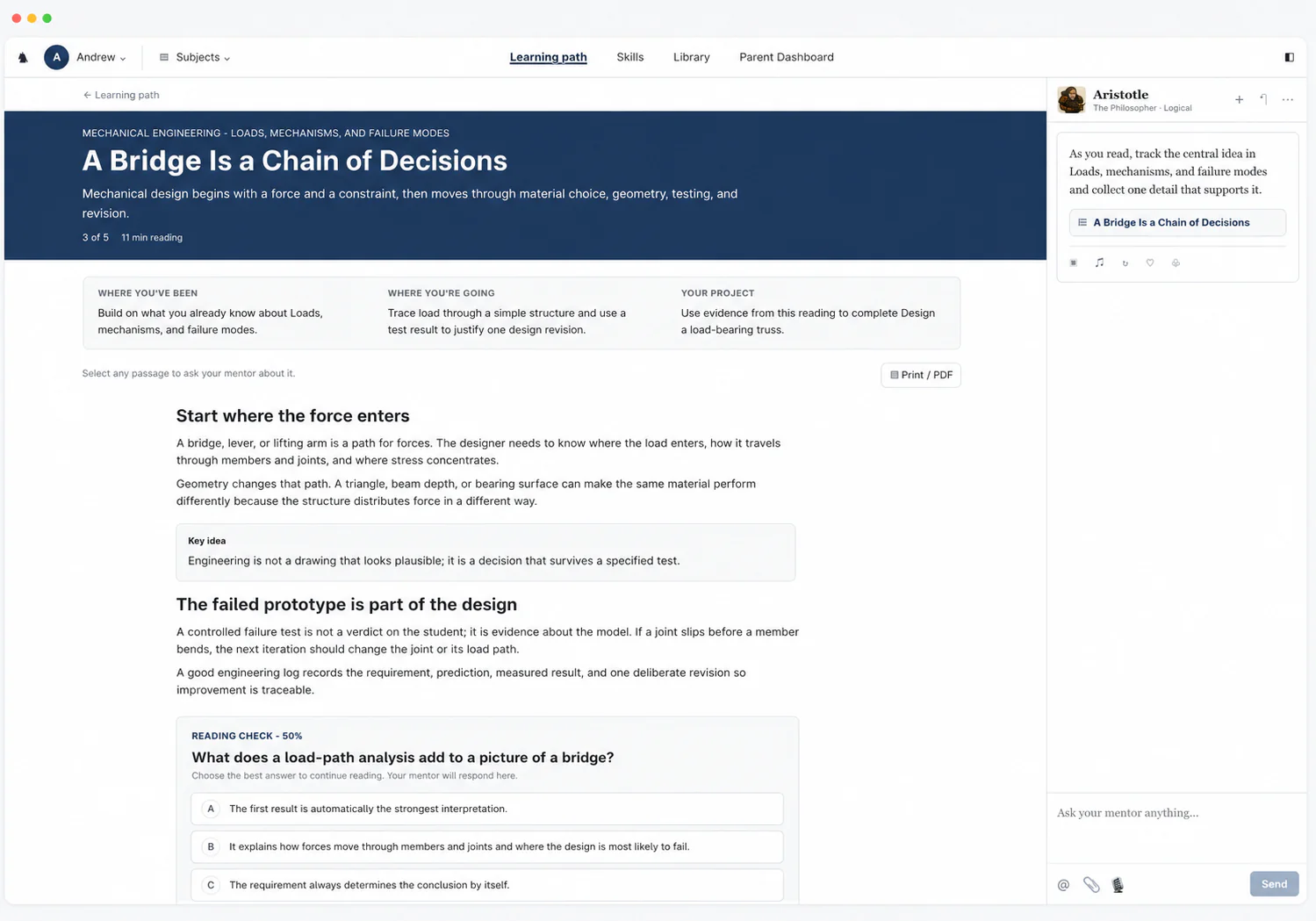
Project-based learning teaches skills by having a child make something real: a model, a report, a business plan, an experiment, a short film. The skills come from the work instead of from isolated exercises, and the child ends with something they can show.

Why projects work
A project gives a skill a purpose. A child learns to measure because the bookshelf needs to fit, or to write clearly because someone will read the result. Projects also require several skills at once: research, planning, math, writing, and revision. That makes them closer to how adults use what they learned.
A project that takes several sessions gives a child a chance to plan, hit a snag, and revise. That practice is different from a worksheet, but projects still need clear steps and feedback to avoid becoming busywork.
A project is different from an activity
Many things called projects are activities that come after the learning: a poster about the water cycle made once the unit is over. The poster shows effort, but the child could finish it without understanding evaporation at all.
In a real project, the skill is needed to finish. Compare the poster with building a sealed jar terrarium that has to keep its plants alive for three weeks without added water. To get it right, the child has to understand how water evaporates, condenses on the glass, and returns to the soil, and a terrarium that dries out or rots shows exactly where the understanding broke down. Three features usually mark the real thing: a problem worth solving, a product someone could use or judge, and at least one round of revision.
Why interest matters
A project on a topic a child cares about can make an assigned skill feel worth using. A child who loves music can investigate sound waves; a child who loves animals can study population data. The topic changes, while the skill and the standard for the work stay clear.

Keep the first version small
A bookshelf project can begin with a drawing and a model rather than a full piece of furniture. The learner measures the available space, chooses dimensions, and checks whether the shelf will hold the books it is intended for. That gives measurement and planning a job before the family commits to materials and adult-supervised construction.
What projects look like at 6, 10, and 15
At 6, a project is short and concrete. A child setting up a lemonade stand makes a price sign and works out that three cups at 25¢ each cost 75¢, which means counting coins and writing numbers a customer can read. One afternoon is the right size.
At 10, a project can run over a week or two and combine subjects. Planning a garden bed 4 feet by 8 feet means finding its area (32 square feet) and the length of the border (24 feet). If each tomato plant needs a 2-foot by 2-foot square, the bed holds 8 plants. A short written plan explaining the choices turns the math into writing practice.
At 15, a project can answer a real question with data. A teenager who thinks a street near home needs a crosswalk can count cars in 15-minute windows at three times of day, average the counts, graph them, and write a letter to the city that states the case and the limits of one week of data from one spot. That single project covers statistics, persuasive writing, and civics.
What the research says
The evidence supports projects that are well designed and guided, and warns against leaving children to discover everything alone. A widely cited 2006 review by Paul Kirschner, John Sweller, and Richard Clark concluded that, for beginners, minimally guided discovery is less effective than instruction that shows them how, and that the advantage of guidance fades once learners know enough to guide themselves.
A randomized trial published in 2022 shows what a well-designed version can do. It compared project-based and lecture-based versions of two high school Advanced Placement courses, U.S. Government and Environmental Science. Students in the project-based classes scored higher on the AP exams, in both courses and among students from both low-income and higher-income families. Together, the two studies suggest that projects work when the skills are taught clearly inside them, not left for the child to stumble on.
How a project goes wrong
One common failure is a project that drifts into crafts: hours of cutting and gluing, and very little of the skill the project was meant to teach. A baking-soda volcano built for the eruption, with no talk of the reaction behind it, is the classic case. Another is the project that grows too big to finish, so it is abandoned halfway and the child learns that projects do not end. A third is the adult quietly doing the hard part, which produces a polished result and a child who could not repeat it.
Look at the decisions behind the result
For the bookshelf, the drawing and measurements show how the learner used scale and units. Explaining why they chose those dimensions, and what would change if the books were taller, shows whether the measurement is understood or only copied, and can point to a useful next lesson even when the model looks finished.
If construction becomes too much to manage, the drawing can be a complete first project. If the measurement work is already familiar, comparing two designs gives the learner another question to investigate. The size of the project can change while its learning purpose stays clear.
How we build projects
Placement, a short adaptive test in each subject, sets where your child starts. Projects use that subject's target skills and the interests you share, so the project itself carries the learning instead of serving as a reward after it.
The Always-On Mentor, software that stays open beside every reading and project, offers help when your child seems stuck and guides each step of a project without completing it for them. We grade everything your child submits as soon as they submit it, so grading never lands on you. When your child gets something wrong, we help them work through it, and projects come back with feedback they can revise from. A polished display alone is not evidence of mastery.