What a high school chemistry course covers
A full high school chemistry course covers matter and its properties, atomic structure and the periodic table, bonding, chemical reactions and stoichiometry, gases, solutions, acids and bases, thermochemistry, and reaction rates and equilibrium. It rests on algebra, because students calculate amounts, concentrations, and energy changes. A student who is weak on algebra will struggle in chemistry for reasons that have nothing to do with chemistry.

What a student should be able to show
Chemistry is a lab science, so the evidence is more than test scores. A student should be able to show:
- Worked problems that move from a balanced equation to an amount in grams or moles.
- Lab reports with a question, a method, data, calculations, and a conclusion that admits what the data does and does not support.
- The ability to explain a result at the particle level: why the reaction happened, not just what happened.
How labs count for college
Colleges and transcripts usually mark a science course as a lab science when it includes hands-on investigation with written reports. Check the admission pages of the colleges your teen is considering, since requirements differ. The lab reports are the proof that the course was a lab course, and we save each one your teen submits.
Labs without a school lab
Some chemistry, such as hazardous reagents or fine-grained equilibrium work, does not belong in a kitchen. Data analysis and written investigations support chemistry learning, but they do not automatically satisfy a college’s hands-on lab requirement. Anything hands-on needs goggles, ventilation, and adult supervision.
What the AP Chemistry path is
AP Chemistry follows the College Board course framework and covers the topics above at college depth, with heavy emphasis on quantitative reasoning and on designing and analyzing experiments. It expects a solid algebra foundation and a first chemistry course behind the student. Students sit the AP exam in the spring. See the College Board course description for the current unit list and exam format.
How our course works
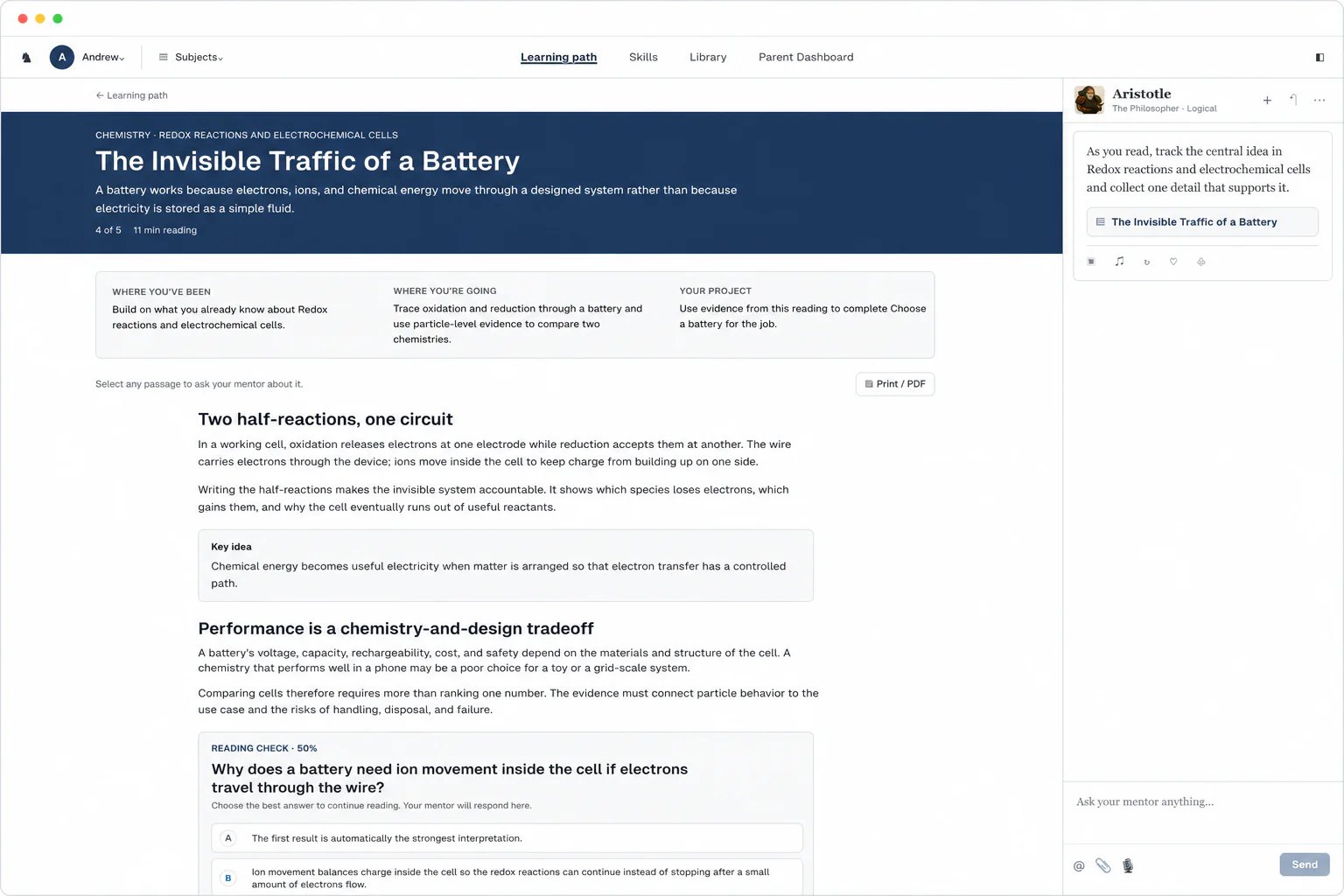
Placement, a short adaptive test, suggests a starting level, so a student who needs algebra practice can begin there while a student ready for chemistry moves into the course. Lessons and projects can use interests as context: a teen who bakes might examine reactions in food, while one who cares about the environment might study water quality. The Always-On Mentor, software that stays open beside every reading, draws a hard idea such as a mole ratio step by step on its board, and after a missed answer can explain the idea another way.
Reading checks are graded instantly. Lab-style investigations and written reports are graded as soon as the student submits them, with written feedback on method, calculations, and reasoning, so you never grade them. Our advanced chemistry course supports AP-aligned study. Check the course page for its title and Course Audit status. A lab-style report alone does not establish that a college will accept a course as a lab science; check the college's requirements.