What a teen urban planning course covers
Urban planning is the study of how cities and towns decide where people live, work, move, and gather. A good teen course covers land use and zoning, transportation, housing, public space, infrastructure such as water and energy, and the environment: parks, stormwater, and heat. It also covers who decides. Plans come from public meetings, budgets, and competing interests, so the course doubles as civics.

What a student should be able to show
This subject produces strong, concrete work. A student should be able to show:
- A map-based analysis of a real neighborhood: how people get around, where the gaps are, what the land is used for.
- A proposal for a specific change, such as a safer crossing, a bus route, or a vacant lot, with the tradeoffs stated and the groups affected named.
- A short presentation or written brief that argues for the proposal and answers the strongest objection.
The test of the work is whether the student can defend a choice with evidence and name what it costs.
Where it fits on a transcript
Urban planning usually counts as an elective, and it draws on several subjects at once. Mapping and data analysis support geography and math, zoning and public process support government and civics, and environmental design supports earth and environmental science. Check your state’s graduation requirements for how an elective credit is defined; the transcript we draft names the course for what it is.

Why the local project matters
Planning is local. A student who studies the intersection near home, the bus line they ride, or the park they use has data they can collect themselves and a real question to answer. That beats a textbook case study, because the student can walk the site, count, measure, and talk to the people who use it.
How our urban planning course works
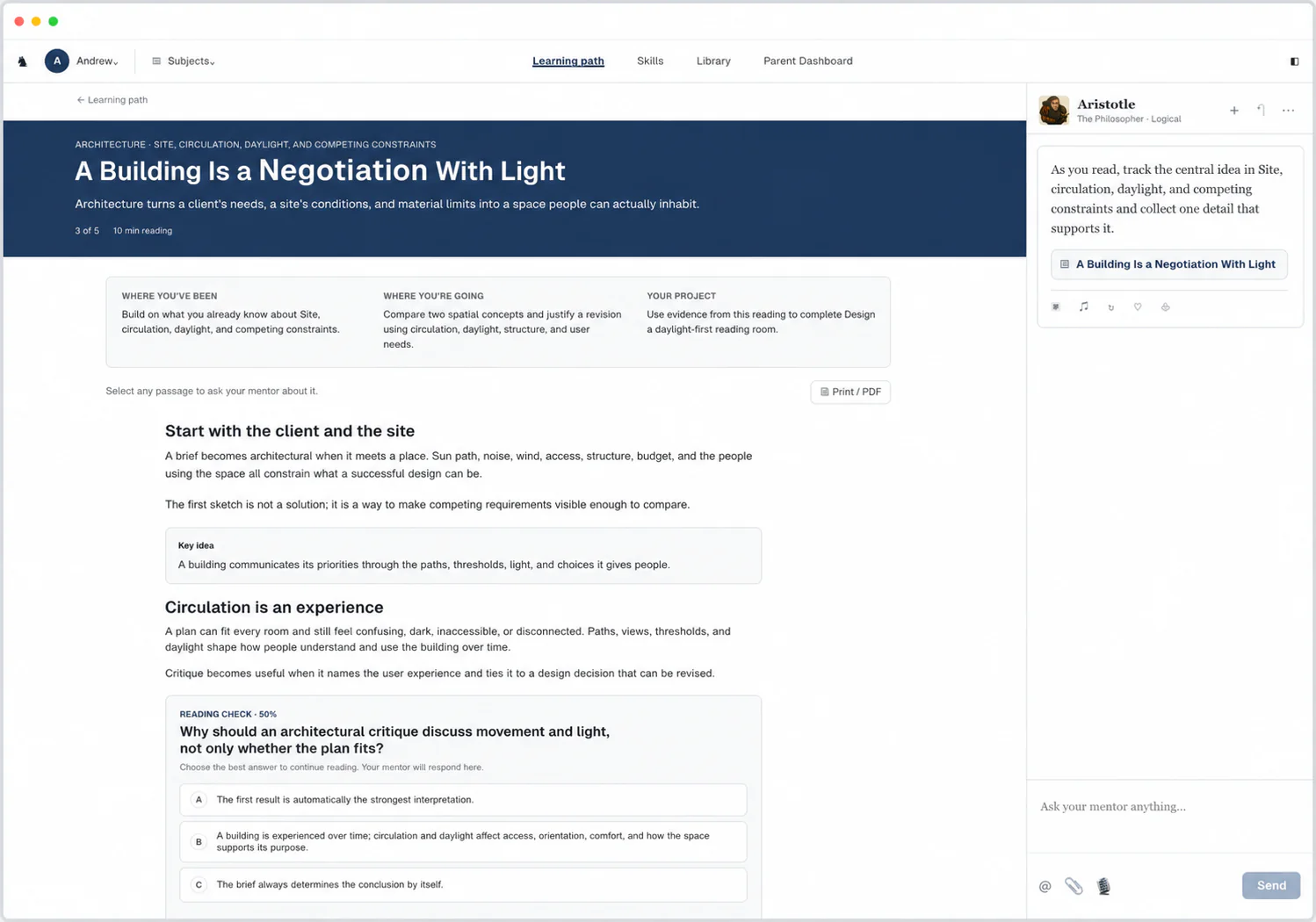
Placement, a short adaptive test, suggests a starting level, and projects can connect the course to interests: a teen concerned about heat might compare shade around two bus stops, while one interested in transit might map how many turns a student makes to reach a library. These are hypothetical examples. The Always-On Mentor, software that stays open beside every reading, can explain a planning term in any passage your teen highlights, and it guides each project step without writing the proposal for them. The proposal still needs evidence, tradeoffs, and a response to an objection.
Reading checks are graded instantly, and analyses and proposals are graded on submission with written feedback on evidence and reasoning, so you never grade them. The course sits in our electives alongside geography, government, and environmental science.