A letter of intent tells your district or state you will homeschool. Here are state deadlines and contents, a sample letter, and how we draft yours.
Does your state ask for one?
The letter exists only where state law asks for it. States also call it different things: a letter of intent, a notice of intent, an affidavit, a declaration, a statement, an enrollment report. They all do the same job.
They tell the state or district that your child is being educated at home, so nobody counts your child as missing from school.
Our requirements checker shows your own state's rule and form. The range looks like this:
- No letter. Texas, Idaho, Illinois, Michigan, Alaska, Oklahoma, and Missouri ask for no notice to homeschool, and neither does Iowa's Independent Private Instruction route. Connecticut's education department asks families to tell the district, though state law does not require it.
- Every year, by a date. New York by July 1, or within 14 days of starting in the middle of the year. Arkansas, Mississippi, and Virginia by August 15, Nebraska by July 15, Washington by September 15, and Wisconsin's online report between July 1 and October 15. Kentucky asks within the first two weeks of the school year.
- Once, before or soon after starting. North Carolina at least five business days before you start, one notice for every child in the household. Florida within 30 days of starting, Arizona within 30 days with proof of your child's age, and Maine within 10 days. Utah and West Virginia ask once, when you begin.
- Once, then a renewal. Ohio asks within five days of starting and again by August 30 each year after. Georgia asks within 30 days of starting and by September 1 each year.
Where the deadline falls after you start, filing before your child's first day at home still means no day goes by with your child absent from school and no homeschool on record.
What goes in it
Most letters are a few lines long. They name the office receiving the notice, say that you will provide home education for the coming school year, identify each child, and end with your name, address, and signature.
Florida's law shows how short the required part can be: a written, signed notice with the full legal name, address, and birthdate of every child in the program.
Some states ask for one or two extras:
- Arizona: a certified birth certificate or other proof of your child's identity and age, and the names of everyone with custody.
- Virginia: a list of subjects for the year, and proof of one qualifying option, such as a high school diploma or a curriculum.
- North Carolina: your home school's name and proof that each teacher has a high school diploma or its equivalent.
- Nebraska: your reason, either religious belief or your right to direct your child's education.
- Pennsylvania: a notarized affidavit or unsworn declaration with education objectives by subject and health records attached.
Leave out what the law does not ask for. Outside Nebraska, a notice needs no reason for homeschooling, and outside the states that ask for a plan, it needs no curriculum, no description of your child's needs, and no request for permission. Extra detail only invites extra questions.
Sending it, and what comes back
Send it the way your state names. Many states now take it online: North Carolina, Wisconsin, Arkansas, and Georgia all have portals. Where you mail or email it, certified mail or a sent email puts a date on record, which helps if the district later asks when you filed.
In almost every state the letter is a notice, not a request, so you file it and begin. Florida's superintendent must register your program when the notice arrives and may not ask for more information. Several states confirm receipt: Ohio's superintendent within 14 days, Utah's school board within 30 days, and North Carolina by email.
New York's district answers by sending its regulations and the form for the next filing. A few states require approval first: in Massachusetts and Rhode Island the district or school committee approves a plan, and Louisiana's state board approves a home study application.
What comes next
In some states the letter only opens the year's paperwork. New York follows it with an individualized home instruction plan (IHIP), due four weeks after the district sends the form or by August 15, whichever is later, then four quarterly reports and a yearly assessment.
When a Florida program ends, the parent files a termination notice with the superintendent within 30 days, along with that year's evaluation.
The letter does not withdraw your child from school either. A school that has your child enrolled needs its own written withdrawal.
Some states also want a short notice when homeschooling ends. Vermont asks for one within 10 business days of stopping, and North Carolina asks you to close the home school in its online portal.
How we draft it
In the Records tab of our Parent Dashboard, your private view of each child's work and records, Paperwork & records lists the documents your state asks for.
Once your family details are filled in, you choose Generate, and we draft your state's notice under its own name, such as a Letter of Intent, an Affidavit of Intent, a Declaration of Intent, or California's Private School Affidavit, ready for you to sign. Until the required forms exist, the dashboard's Needs you list shows Create required forms.
The same list covers later filings where a state has them, such as New York's plan and its reports each quarter. If your state needs no notice, as in Texas, the page says so, and the documents you do need, such as a withdrawal letter for a child leaving school, are there instead.
The one thing nobody can draft for you is a document only you hold, such as a birth certificate or an immunization record.
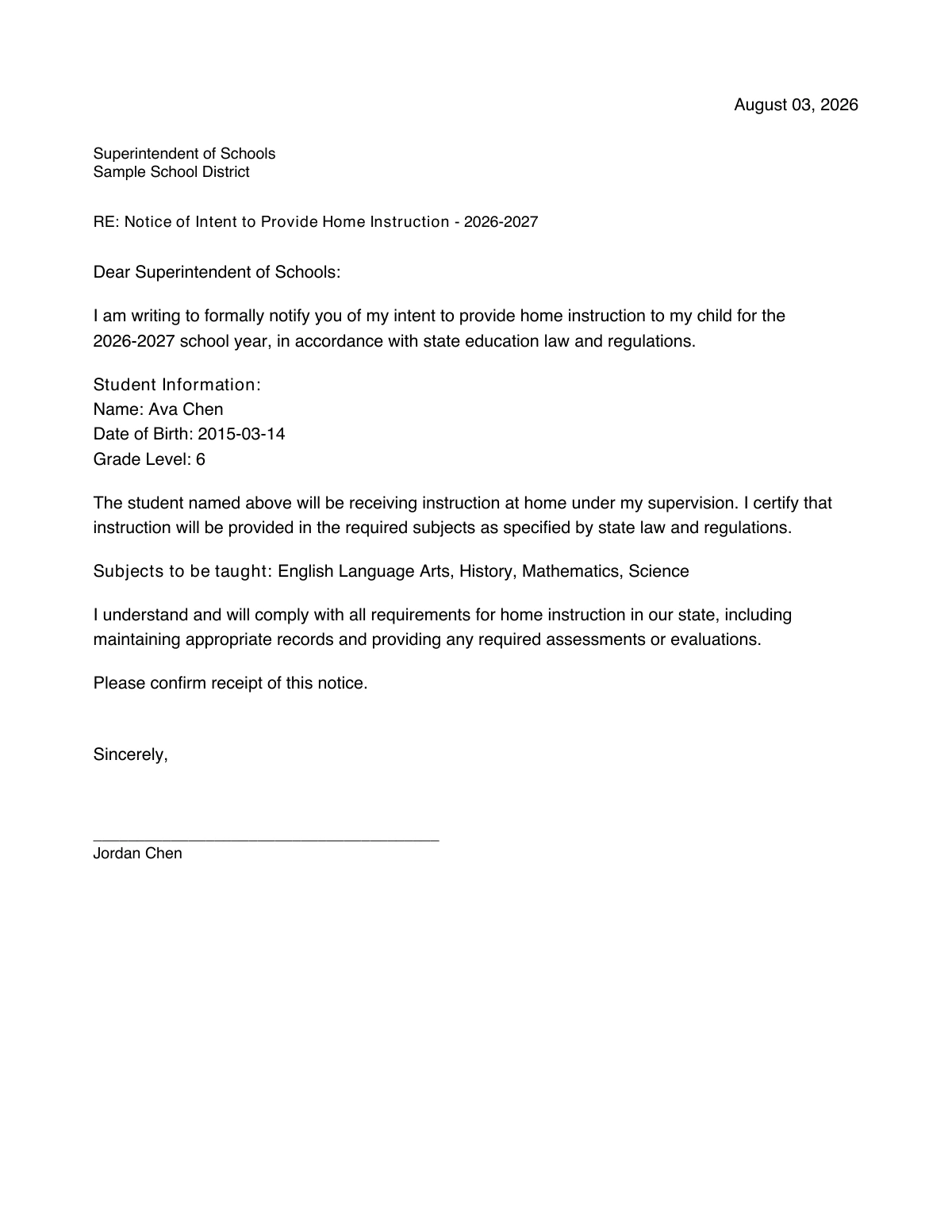
Sample letter, if you write your own
If you would rather write your own, a letter of intent follows the shape below. Where your state or district has an official form, such as Hawaii's Form 4140 or North Carolina's online notice, use the form instead of a letter.
A letter of intent is short on purpose: four parts, one page, facts only. The sample covers the details most states ask for; add any extra your state lists, such as Arizona's proof of age or Virginia's list of subjects.
Sample letter of intent
Replace each bracketed item. Check your state's required details before sending.
- Date and recipient
- [Date]. To [office your state names, such as the district superintendent], [address or submission channel].
- Notice
- I am writing to notify you that I will provide home education for [child's full legal name] during the [school year] school year, beginning [start date]. [Child's date of birth and grade, if your state requires them.]
- Parent and address
- [Parent or guardian's full legal name], [home address], [school district, if required], [phone or email].
- Signature
- [Parent or guardian's signature and date].
Frequently asked questions
- What if we start homeschooling in the middle of the year?
- Most deadlines then run from the day you begin rather than from the usual yearly date, so file soon after you start, or before.
- Do I send a new letter if we move?
- Often. The letter goes to the district or county where you live, so a move can mean a new letter there, and a move to another state means following that state's rule from the start. Hawaii, for example, asks for a new notice when your child's assigned school changes.
- Do I need one letter per child?
- It depends on the state. North Carolina takes one notice for the whole household, and others, such as Vermont, want one per child.
After the filing, the teaching is ours
We place your child in each subject, teach every lesson, and grade the work as it is submitted.
$149/month per child after the trial.
Sources (6)
- New York: 8 NYCRR 100.10, home instruction
- New York State Education Department: Home Instruction Questions and Answers
- Florida Statutes section 1002.41: home education program
- North Carolina Division of Non-Public Education: opening a home school
- Code of Virginia section 22.1-254.1: home instruction
- Texas Education Agency: home schools letter