What homeschooling costs with us in 2026: $149 a month per child for every subject, less for siblings, plus the rest of a family budget and the state funding that can pay for it.
What homeschooling costs with us
School in a Box, our full plan, is $149 a month for one child. It covers up to 12 active subjects at once, from kindergarten through 12th grade, including custom electives we build on any topic your child cares about. Over 12 paid months that is $1,788 a year.
Family pricing applies on its own as soon as a second child is on School in a Box, and every child moves to the lower rate:
- Two children: $125 each a month, $1,500 each a year.
- Three children: $100 each a month, $1,200 each a year.
- Four children: $85 each a month, $1,020 each a year.
- Five or more: $75 each a month, $900 each a year.
Single Subject is $49 a month for one subject, $588 over a year, for a child who needs one course, such as math or chemistry. Every plan starts with a 14-day free trial, and billing begins only after it ends.
What the price pays for
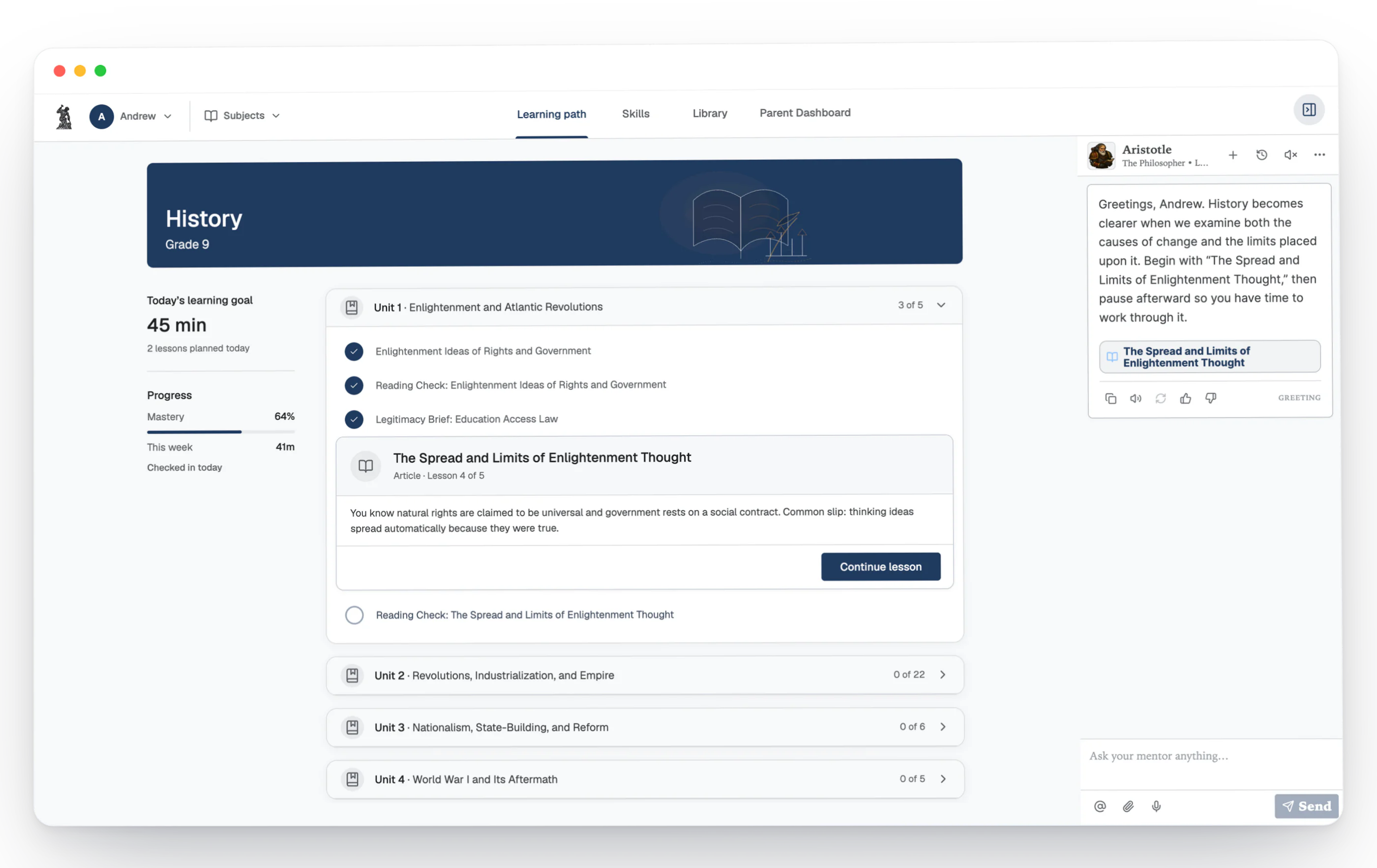
The price replaces the work that usually fills a homeschooling parent's day, not just a stack of books. Each subject starts with a placement test that finds where your child is ready to begin, so nobody pays for a year of material your child already knows.
From there we write every lesson, starting at your child's level, with examples drawn from their interests where one fits.
Our Always-On Mentor is the help a family would otherwise pay a tutor for by the hour, and it comes inside the lessons.
Your child can highlight a passage to ask about it, hear a word pronounced, or have the idea drawn on the mentor's board, and the mentor offers help on its own when it looks like your child is having a hard time, explains another way after a wrong answer, and coaches projects without doing them.
We grade everything your child submits as soon as they submit it, so grading never lands on you. When your child gets something wrong, we help them work through it, and projects come back with feedback they can revise from. The record is included too.
Attendance builds itself from the daily check-in, hours are counted for each subject, and our Parent Dashboard drafts your state's documents, from a letter of intent to a high school transcript, ready for your signature.
The rest of a homeschool budget
Some costs depend on what your family already owns and what your child does outside lessons, so they vary more than any curriculum price. It helps to split them into what you buy once and what comes back every year.
Mostly one-time
A computer or tablet for each child who works at the same time, and home internet. A printer helps if you like paper copies; lessons and reading checks can be printed from Grade 3. For kindergarten through 2nd grade, add pencils and paper for handwriting, since a photo of the page goes into your child's work.
You do not need to buy textbooks or teacher guides; the lessons are the readings, and the Library's Free Read shelf holds classic books with the mentor beside them.
Recurring
Activities replace what a school bundles in: team fees, music lessons, clubs, outings, and the travel to them. Science at home can mean a few household supplies for a project.
Testing or evaluation fees come back each year in some states. North Carolina requires a standardized test every year. Pennsylvania adds testing in grades 3, 5, and 8 to a yearly portfolio review, Georgia tests every three years from the end of 3rd grade, and Florida asks for a yearly evaluation by a test or an evaluator. Test and evaluator fees vary, so ask the provider before you book.
Parent time, the cost most estimates leave out
For many families the largest cost of homeschooling is not money spent but income given up. Work out your own number: the hours of paid work a parent would give up each week, times the hourly pay, times the weeks in the school year.
A parent who cuts 20 hours a week at $25 an hour for 40 weeks gives up $20,000 before taxes. That is an illustration, not an average.
That number can be much smaller. Because we teach, grade, and keep the records, homeschooling does not need a full-time teacher at home. There are no live class times, so lessons fit around a work schedule, and the mentor is there when you are not.
Young children still need an adult nearby; a teenager can run most of the day alone.
Costs that come with high school
Most high school costs are outside exams. AP exams are $99 each for the May 2027 exams, plus $40 per exam when it is ordered after November 13. A homeschooled student takes them at a local school that gives AP exams, and that school may charge more to cover its own costs.
The SAT and ACT have their own registration fees, paid to the College Board or ACT.
Dual enrollment, college courses taken during high school, can be free or full price depending on your state.
Florida exempts dual enrollment students, home education students included, from registration, tuition, and lab fees; Georgia's program covers tuition, mandatory fees, and books at participating colleges; and North Carolina's Career and College Promise is tuition-free for eligible juniors and seniors from registered homeschools. Our dual enrollment guide covers each state.
The courses themselves are part of School in a Box: our 40 advanced courses built on AP frameworks, SAT prep, and ACT prep cost nothing extra.
State money that can pay for homeschooling
A growing number of states pay toward homeschool costs, through an education savings account (ESA), where the state deposits money for approved expenses, or through a tax credit or deduction.
We are an approved vendor for four programs, so families there can pay for our plans from their account balance: the Arizona ESA, Alabama's CHOOSE Act, and New Hampshire's Education Freedom Account through ClassWallet, and Utah Fits All through Odyssey. Our ESA payment page shows how.
These are the larger programs open to homeschooled students, with the amounts each program publishes for 2026-27. Each has its own eligibility rules, approved expenses, and application window.
| State | Program | Amount |
|---|---|---|
| Alabama | CHOOSE Act refundable credit | $2,000 per home-education student, up to $4,000 per family |
| Idaho | Parental Choice Tax Credit, refundable | Up to $5,000 per student, $7,500 with a qualifying disability |
| Texas | Education Freedom Account | $2,000 a year for a student educated at home |
| Utah | Utah Fits All Scholarship | Up to $4,000 for home-based students ages 5 to 11, $6,000 for ages 12 to 18 |
| West Virginia | Hope Scholarship | $5,435.62 expected for a full year |
| Oklahoma | Homeschool tax credit, refundable | Up to $1,000 per student a year |
| Indiana | Education expenses deduction | $1,000 per eligible child |
| Iowa | Tuition and Textbook Credit | 25% of the first $2,000, up to $500 per student |
| Ohio | Home School Expenses Credit, nonrefundable | Up to $250 per student |
Read the rules before you take the money. In Arizona, ESA students are a separate legal classification from homeschool students, so joining changes your child's status. Our tax credits by state guide covers every state, and the reimbursement directory lists local programs too.
Frequently asked questions
- What should I check before spending ESA funds?
- Check your program's approved expenses and providers, whether a purchase needs approval first, and which receipts to keep. Follow the program's payment steps before buying.
- When does family pricing apply?
- Automatically, as soon as a second child is on School in a Box, counting each child from their first paid month. Single Subject keeps its own rate and does not count toward family pricing.
- Is anything charged during the free trial?
- Only a $1 parent verification, when your child is under 13 or has no age on file. It confirms you are the parent or guardian, and we refund it within 3 days.
- Does the price go up in high school?
- No. The price is the same from kindergarten through 12th grade, before family pricing.
Start with two free weeks
Your child works through real lessons in every subject you choose, graded as they go, before your first subscription charge.
$149/month per child after the trial.
Sources (10)
- College Board: AP exam fees
- Alabama Department of Revenue: the CHOOSE Act
- Idaho Parental Choice Tax Credit
- Texas Education Freedom Accounts
- Utah State Board of Education: Utah Fits All Scholarship
- West Virginia Hope Scholarship: FAQ
- Oklahoma Tax Commission: Parental Choice Tax Credit
- Indiana Department of Revenue: education expenses deduction
- Iowa Department of Revenue: Tuition and Textbook Credit
- Ohio Department of Taxation: IT 1040 instructions