Deschooling is a break after leaving school for rest and curiosity to return. Here is how long it lasts, what your state still expects, and how lessons restart.
What deschooling is
School teaches more than its subjects. Children also learn to wait for a bell, to ask permission, to work for a grade, and to see learning as something that happens in one building between 8 and 3.
Deschooling is the time it takes to unlearn those habits after a child leaves school, so that learning at home does not feel like school with a different address.
In practice it is a break from formal lessons. Your child rests, plays, reads what they like, and follows questions for their own sake. It is not a vacation from learning: children learn constantly in those weeks. They just learn without a timetable.
Does your child need it?
Not every child does. A child who left school for practical reasons, such as a move or a sport's schedule, and who is eager to start, can go straight to lessons. Deschooling matters most when school itself was the problem:
- Your child left anxious, exhausted, or dreading anything that looks like school.
- They were bullied, or school refusal had already started.
- They have learned to do the minimum for a grade and nothing more.
- They have stopped asking questions, reading for fun, or making things.
If several of these fit, a break is likely to pay for itself. If your child's distress feels like more than school fatigue, talk to their doctor as well.
The legal step comes before the break
Deschooling starts after your homeschool legally exists. If your child is enrolled, withdraw and file any notice your state requires first, so the break is not counted as unexcused absences. Our guide to withdrawing from school covers the steps, and we draft the letters.
Then check whether your state counts instruction time, because the break sits inside the year:
- No count: Texas and Illinois set no minimum number of days or hours, so a break has no legal clock.
- Days: Georgia asks for 180 days of at least four and a half hours each.
- Months: North Carolina asks for a regular schedule for at least nine calendar months of the year.
- Hours: Washington asks for 1,000 hours a year. New York asks for 900 in grades 1 to 6 and 990 in grades 7 to 12, and its quarterly reports list the hours taught each quarter, so a long break shows up on the next report.
How long it lasts, and how you know it is over
There is no set length. For a child who left a merely boring year, two or three weeks may be enough. For a child who left after bullying or months of dread, it can take two or three months before the idea of a lesson stops being upsetting.
Two things tend to decide it: how hard the last stretch of school was, and how quickly your child's own curiosity returns. Pick a date a few weeks out to talk about how it is going, and adjust from there rather than committing to a fixed number of months.
Readiness usually shows up in small ways. Your child starts asking questions again, picks up a book or a project without being asked, or says they are bored, which after a hard year is good news. Sleep has settled, and the word school no longer brings a flinch.
When two or three of those are true, a first short lesson is likely to land.
What to do during deschooling
The goal is to let your child rediscover that learning can be their own idea. A good deschooling week has plenty of unstructured time and a few anchors:
- Rest: more sleep, slower mornings, and time outdoors every day.
- The library: let your child choose any books, including the ones you would not pick.
- Making things: cooking, building, drawing, fixing a bike, a garden, or a craft that takes days to finish.
- Following a question: when your child asks how something works, look for the answer together instead of turning it into a lesson.
- Talking about school: what felt hard, what was boring, what they actually liked. Those answers shape what comes next.
Expect some extra screen time; it is normal in a break. If screens crowd out everything else for weeks, set the limits you would set at any other time.
Deschooling for parents, too
Parents bring school habits home as well. The biggest is the picture of a six-hour day: at home, a child learns in far less time, because there is no roll call, no lining up, and no waiting for 25 classmates. A quiet day is not a failed day.
The second is the urge to become the teacher, standing at a whiteboard and grading worksheets at night. Here, that job is not yours. Your role is the parent's role: noticing what lights your child up and making room for it.
The third is guilt. Many parents spend the first weeks of a break worrying that their child is falling behind a class they no longer belong to. Once your child is homeschooled, there is no class to fall behind, and the restart described below begins from whatever your child knows on that day.
That frees the break to do its job, and it frees you to rest too, since the months before a withdrawal are usually hard on the whole family.
Coming back to lessons with us
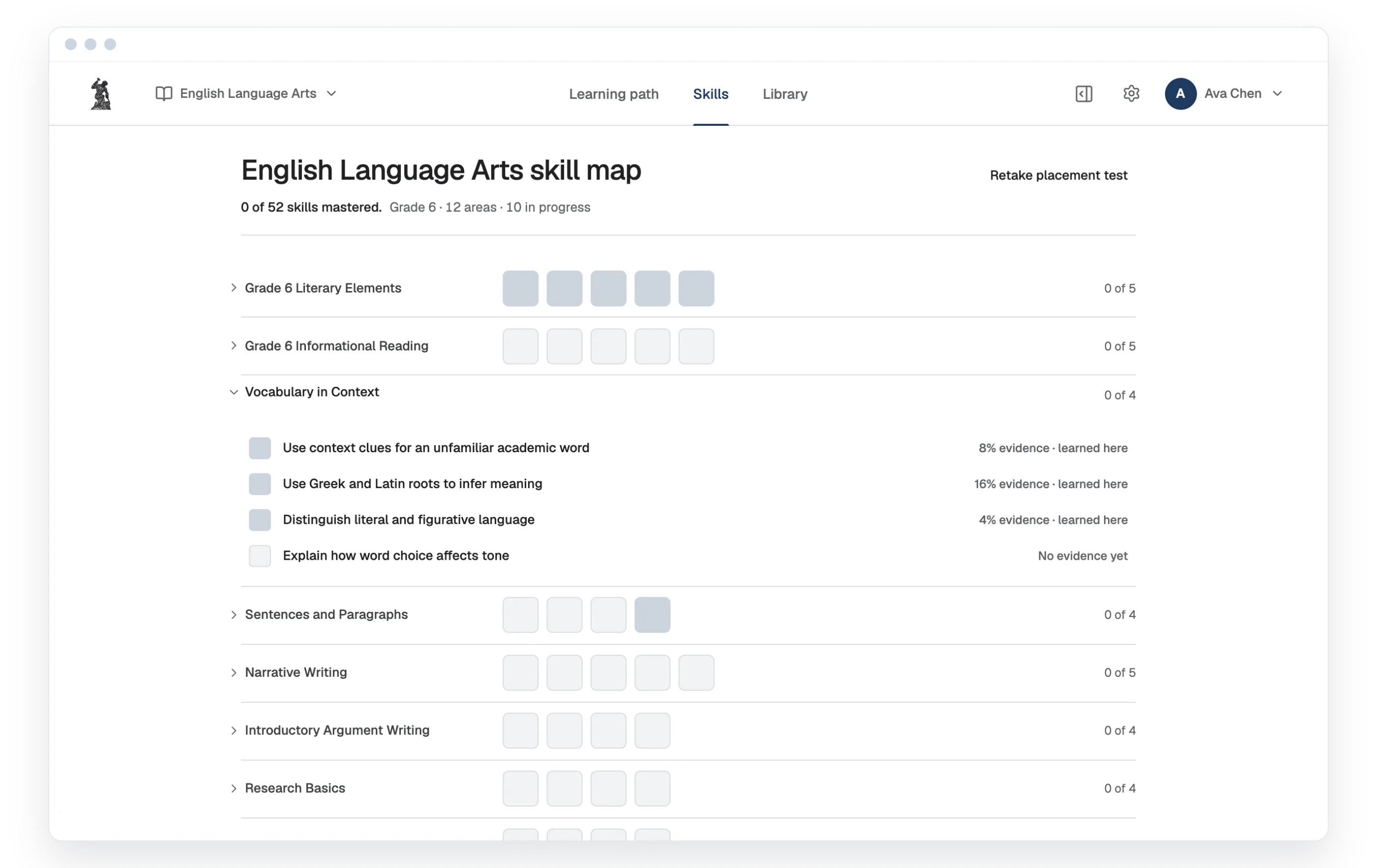
The restart can be as gentle as the break. Placement, the short test that sets where each subject starts, has no timer and adapts to every answer, so it can happen on a calm morning, one subject at a time.
In the weekly plan, choose two or three days and a single 20-minute block to begin, then add time as your child is ready.
Lessons draw examples from your child's interests where one fits, and on School in a Box, our full plan with up to 12 subjects at once, the thing your child fell in love with during the break, dinosaurs or bridges or baking, can become a custom elective.
Our Always-On Mentor is there when a lesson raises a question: your child can highlight anything to ask about it, hear a word read aloud, or ask for a drawing on the mentor's board.
It offers help when it looks like they are having a hard time, explains things another way after a wrong answer, guides projects without doing them, and helps with reading-check questions without giving the answer away. Grades come right away, and a project can always be revised and resubmitted, so the first weeks back carry no fear of failing.
Frequently asked questions
- Should my child do any academics during deschooling?
- Only what they choose. Reading, building, and following questions are learning; formal lessons can wait until the break ends.
- Can we deschool in the middle of the year?
- Yes. The break can start whenever your child leaves school, as long as your state's withdrawal and notice steps are done first.
- What if my child never seems ready?
- Start anyway with one short block on a subject they like. Readiness often follows a first good experience rather than coming before it.
Lessons that restart gently
Begin with one short block a day on something your child already loves, and add the rest when they are ready.
$149/month per child after the trial.