A homeschool year needs subjects, levels, a sequence, weekly time, and a legal calendar. You choose the subjects and hours; we build and sequence the rest.
What a year's plan has to cover
Planning a homeschool year by hand usually eats a summer. A parent picks a program for each subject, guesses a level, maps the books onto 36 weeks, builds a weekly timetable, sets up a gradebook, and puts the state's deadlines on a calendar.
Then October arrives, one subject is too easy, another is too hard, and the map has to be redrawn.
The plan splits differently. You make two decisions: which subjects, and how many hours a week. Everything that depends on your child's actual progress, which is where hand-made plans break, is ours. We set the level in each subject and the order of lessons and review. We also grade the work and keep the records the state wants.
The plan adjusts as your child works, so nothing has to be redrawn in October.
Choosing the subjects
Start from your state's list. Some are long. New York's grades 1 to 6 list covers arithmetic, reading, spelling, writing, English, geography, U.S. history, science, health, music, visual arts, and physical education. Washington's covers occupational education, science, math, language, social studies, history, health, reading, writing, spelling, and art and music appreciation.
Others, such as Idaho's, ask only for the subjects public schools usually teach. The requirements checker shows yours.
Every child starts from the four core subjects: math, English language arts, science, and history. From there you add electives, world languages, or a custom subject on any topic your child cares about. School in a Box, our full plan, runs up to 12 subjects at once.
A balanced year for a 10-year-old might be the four core subjects plus arts and a custom elective on space exploration; a 15-year-old might take algebra, biology, English, history, Spanish, and computer science.
A starting level in each subject
The level decision is the one that most often sinks a hand-made plan, because a child's grade says little about where they are in each subject. Placement, a short test in each subject that steps up after a right answer and down after a wrong one, makes that decision from evidence.
It runs 25 questions with no timer, or 12 read aloud for children in kindergarten through second grade.
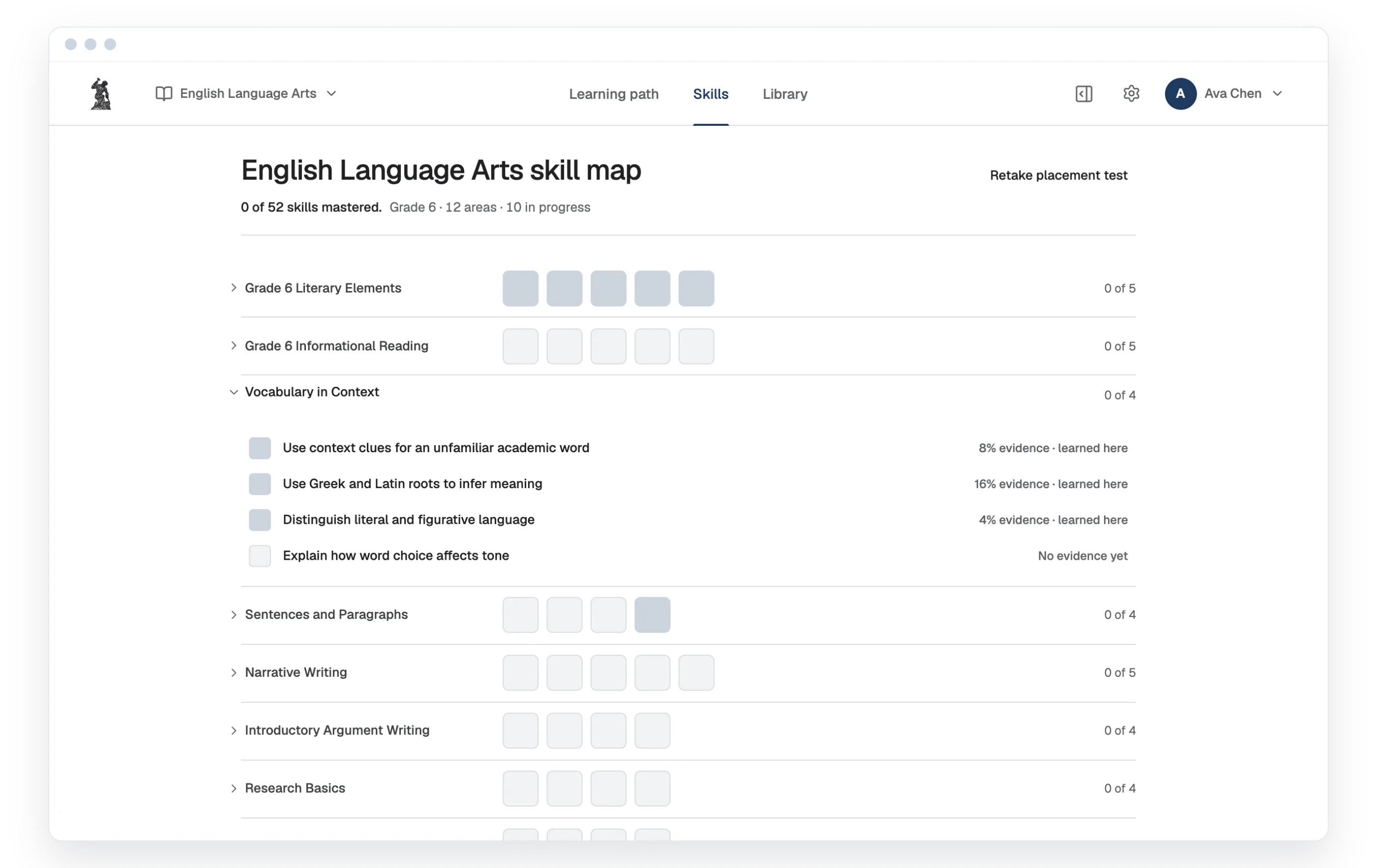
The result is a starting point within a grade in each subject, with the skills already shown skipped and any earlier gaps first. The skill map lays out every skill in a course with the evidence behind it. If a start turns out wrong, your child can retake placement there. A retake keeps the work your child already finished.
The sequence inside each course
Each subject is a path of units that runs in order, so every skill builds on the ones before it. Within a unit, your child moves through lesson readings, reading checks, skill activities, projects, and checkpoints.
Each unit has a midpoint and a final project and benchmarks, and review checkpoints come at least every three lesson groups so earlier skills come back before they fade.
Every lesson tells your child where they have been, where they are going, and which project it leads to, and it draws examples from their interests where one fits.
The pace comes from your child: they move on when the reading check shows they are ready, so a strong subject can run ahead of the calendar and a hard one can take the time it needs. There is no 36-week map to keep up with.
Help inside each lesson comes from the Always-On Mentor, a guide that stays open on the screen while your child reads. Your child can highlight a passage to have it explained another way, pronounced, or drawn step by step on the mentor's board.
The mentor also offers help on its own when it looks like your child is having a hard time, explains differently after a wrong answer, guides projects without giving the answer, and clarifies reading-check questions without pointing to the right choice.
Weekly time, and what your state counts
Time is your second decision. In our Parent Dashboard, the weekly schedule turns it into a week: choose the weekdays, start time, daily minutes, block length, and break length, and it fills blocks of 20 minutes or more, up to eight a day, rotating through your child's subjects.
Your child sees each day as their Today card, and the week prints for the fridge.
If your state counts hours, do the arithmetic once. New York's 900 hours for grades 1 to 6 is five hours a day across 180 days, or a little over four hours a day if school runs year-round on four days a week. Washington's 1,000 hours is about five and a half hours across 180 days.
Georgia counts days instead: 180 of at least four and a half hours. Texas and Illinois count neither. Your child's daily check-in and activity become the attendance record, so you can see the total grow.
Grading and progress, with no gradebook to set up
We grade everything your child submits as soon as they submit it, so grading never lands on you. When your child gets something wrong, we help them work through it, and projects come back with feedback they can revise from.
Our Parent Dashboard shows the year as it unfolds. Its Progress tab lists each subject's grade level, mastery percentage, and lessons completed. The Needs you list on Home surfaces the latest grades with feedback and the records ready to sign. It also flags anything still unfinished, such as a subject waiting for placement.
Your state's legal calendar
Most of a homeschool's legal dates fall in summer and early fall, so put them in the plan before the year starts. A few examples of yearly deadlines:
- New York: letter of intent by July 1; home instruction plan by August 15 or four weeks after the district's forms, whichever is later; four quarterly reports on the dates in your plan.
- Pennsylvania: affidavit by August 1; evaluator's certification by June 30.
- Virginia: evidence of progress by August 1; notice of intent by August 15.
- Ohio: yearly notice by August 30. Georgia: Declaration of Intent by September 1. Washington: declaration of intent by September 15.
- California: Private School Affidavit between October 1 and 15.
When a filing is due, the Needs you list can prompt you to create the required forms, and the document tools draft each one from your family details and your child's record: a letter of intent, an individualized home instruction plan, a quarterly report, an affidavit, or an attendance record, ready to sign.
Checkpoints through the year
A plan that runs itself still benefits from a few moments to look up from it. Each season has one:
- Back to school: set up any new child, choose this year's subjects, let placement set the levels, and set the weekly schedule's hours. File your state's yearly notice.
- After the first month: look at Progress. A subject moving very slowly may need a retaken placement or a change of grade.
- Midyear and the new year: add a subject if your child is ready for one. It starts with its own placement, and the others carry on where they were.
- Spring: in testing states, arrange the test. North Carolina tests every year, and Pennsylvania in grades 3, 5, and 8.
- Year end: generate the attendance PDF and learning summary, plus the transcript and course descriptions for a high schooler, whose transcript counts each school year from July to June.
- Summer: keep a lighter schedule going or stop. The path waits where your child left it.
Frequently asked questions
- How many subjects should my child take?
- Start with the four core subjects and one or two electives your child wants, then add more as the week allows, up to 12 at once on School in a Box.
- Can you plan all four years of high school?
- We do not offer a four-year planner. Each year, your teen's active subjects become that year's transcript courses; our graduation requirements by state guide shows what to aim for.
- Does summer learning count toward the school year?
- Summer lessons are recorded like any other day through your child's daily check-in. Whether your state counts them toward the year depends on its rules, which the requirements checker shows.
A year planned before the first lesson
Pick the subjects and the hours, and placement, sequence, grading, and paperwork follow from there.
$149/month per child after the trial.
Sources (9)
- New York 8 NYCRR 100.10: home instruction
- Washington OSPI: laws regulating home-based instruction
- Pennsylvania Department of Education: Home Education and Private Tutoring
- Virginia Department of Education: Home Instruction Handbook
- Ohio Department of Education and Workforce: Home Education Fact Sheet
- Georgia Department of Education: Home Study Guidance
- California Department of Education: Schooling at Home FAQ
- North Carolina Division of Non-Public Education: testing FAQ
- Idaho Department of Education: homeschooling FAQ